5 ways it pays to be a member

Could a professional network be the answer you’re looking for?

Not everyone is a ‘joiner’ – in fact, some people even dread the idea of talking to strangers at professional events! But no matter what industry you work in, networking is almost inevitably something you’ll need to do at some point. The good news? By tapping into a network of like-minded career people, you may gain a lot more than you expect. Whether you’re an aspiring entrepreneur or a well-established manager, joining a professional membership organisation can be a great way to connect with people you’d never otherwise meet, and gain unexpected benefits.

We asked a few of the Institute’s Members what motivated them to first join up, and why they benefited from being part of the IML ANZ community. Here are a few of their answers – if you can relate to any of these, perhaps it’s worth signing up for a professional association!

1. When you want to get to the top, pronto.

If you have clear career goals in your sights, and you want to achieve them as quickly as possible, then it’ll certainly pay to put yourself out there. By joining a membership organisation, you’ll have plenty of opportunities to do just that – whether it’s by attending events, connecting online, or contributing content to a blog or LinkedIn. Building a professional profile is especially important when you’re first establishing your career (or when you are trying to establish yourself as an expert in a field or on a topic). After all, no matter what business you’re in, it helps to meet people you wouldn’t cross paths with in the office kitchen – broadening your perspective, opening up potential job opportunities down the track or seeking out business development opportunities. As the old adage goes, “sometimes it’s who you know, not what you know.”

2. When you’re running a business, and feeling a little isolated.

Running your own show has many perks: freedom and flexibility for a start. But while it’s exciting, the life of an entrepreneur can also be a lonely one – and you may find yourself missing those small human interactions you once took for granted in a bigger office. This is where being a Member of an organisation like IML ANZ can make all the difference. Not only do you have events to look forward to, you can even take advantage of Member lounges – a great alternative to working from home! Not only is it nice to bump into new people on a social level, it can open up new doors professionally too. Who knows, maybe that nice person sitting beside you is your next big client?

3. When you’ve reached a career plateau, and aren’t sure what’s next.

When you’ve been working in the same industry for a while, a time might come when you hit a wall. You’re not sure how to progress, or what direction to move in – and chances are, there will be a limit to how much people in your existing organisation can help you. If you’re in this particular boat, it can really help to take a step back and talk to people outside your immediate orbit – and of course, joining a professional community is an easy way to find them.

Seeking advice from people with different perspectives can help you see your own situation more clearly, and it could even inspire you to make a career change you’d never previously considered. You might have a light bulb moment attending one of our Masterclasses. Otherwise a lot of our Members find the reading material provided (like the quarterly magazine, Leadership Matters) very useful, as it’s designed to provoke thought and spark new ideas.

Or if you really want to stand out, IML ANZ is also the only organisation to offer the Chartered Manager accreditation: an internationally recognised designation that can really set you apart.

4. When you’ve got a dilemma you’re not sure how to solve.

While it’s easy to ask for help when you’re starting out in your career, it can become harder as you rise up through the ranks of management. Not only will there be fewer people around who are more senior than you, there can be politics that prevent you from wanting to seek their help. That said, no matter how experienced you are, there will be moments when you need a second opinion – maybe you have a tricky employee to manage, or maybe you’ve lost touch with what’s considered best practice in your sector.

This is certainly a time when a membership organisation like IML ANZ can help. As well as connecting you with valuable learning resources (including videos, articles, e-books and research), the Institute can also put you in touch with people who’ve ‘been there, done that’ – peers who can provide guidance without any strings attached. Because, no matter what level you’re at, leadership is a skill that you never stop learning.

You also have the chance to find a mentor to give you personal guidance – which is a serious advantage in our competitive job market. It might be just the circuit breaker you need!

But mentoring isn’t just for those who are seeking guidance…

5. When you’ve reached a point where you’d like to give back.

Chances are, you won’t have reached your current level of success without the help of at least one or two people. If you were really lucky you may have even had a mentor who shared their advice and knowledge at critical points in your career. What’s important to remember is that these relationships aren’t just valuable for the mentees – they’re also very satisfying for the mentors. If you’re at a stage in your career where you have valuable wisdom and life lessons to share, why not give back by becoming a mentor? Doing so through a membership organisation means you can make a real contribution to your industry. You might even find yourself learning a thing or two from the people you mentor – and at the very least, you’ll gain fresh insight into topics you thought you knew back to front.

Curious about how IML ANZ Membership works, and what it costs? Click here to check out more about our professional community.

Accreditation: The secret to a successful transition

Humans are hardwired to resist uncertainty. It’s no wonder change can be daunting even for some of the most resilient people – those in the defence force.

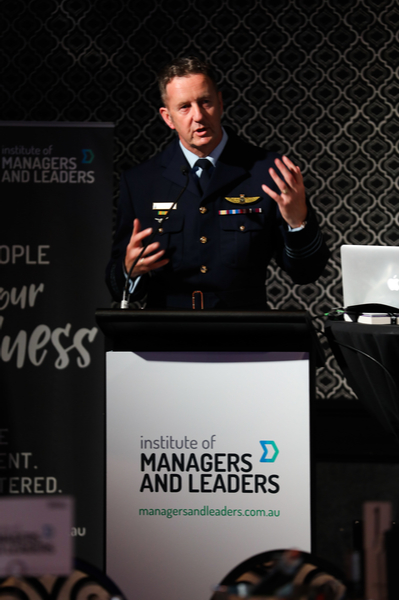
Paul Hughes CMgr FIML

In 2018, the Department of Defence released the Transition Taskforce report, that estimates around 5,500 to 6,000 members of the defence force leave active service annually. That means thousands of men and women make a life-changing transition every year.

The same report reveals that a significant barrier to an effective transition is feeling unprepared, or ill-equipped to manage the differences between the military and civilian environments.

It’s a common feeling. “There’s always that fear, I know I felt it when I made the change when I left the Royal Air Force,” recalls Paul Hughes CMgr FIML, former Officer Commanding 3 Wing Australian Air Force Cadets and now a client relationship manager for Converge International, one of the largest employee assistance providers in Australia.

“I think it’s because it’s perceived as two different worlds, the military and the ‘civvy’ (civilian) world. But they’re more similar than what people imagine.”

Minding the gap

And where there are differences in these two worlds, it seems veterans simply need to validate the skills they already gained in service.
That’s what Ben Urquhart CMgr AFIML, a communications electronic technician for the RAAF who later secured leadership roles at Saab Australia, Ultra Electronics and Kongsberg Defence Australia, discovered.

Ben Urquhart CMgr AFIML

“One of the challenges coming out of service was that I didn’t know how to talk to civilians,” says Urquhart. Not that he lacked communication skills, but he had to adjust his style to suit a new audience – one that didn’t have the military mindset. Urquhart points out that it was “the communication skills to motivate people,” that he crucially needed.

Urquhart looked towards leadership skills development to close that gap and completed a diploma course. However, he reached a stage in his career where classes just weren’t enough. “I considered doing an engineering degree but quickly realised that I wanted to stand out for my management and leadership skills, not my technical skills,” says Urquhart. So Urquhart applied to become a Chartered Manager, the highest accreditation available for managers and leaders.

Hughes believes this is a vital step for those wanting to validate their skills as they exit the defence force. “Accrediting your skills is a key move. It’s about realising your worth and value, knowing what you can bring to the table and getting formal recognition for it,” says Hughes.

Three tips on making a successful transition

Both Urquhart and Hughes believe that there are many practical steps to take if you want to make a successful career transition into the civilian workplace.

  • Network with non-military professionals. Urquhart has thoroughly enjoyed networking with leaders from different industries as a member of the Institute of Managers and Leaders Australia and New Zealand (IML ANZ). It has opened his mind to the way others have achieved success. Plus, the Transition Taskforce report lists establishing new networks as one of the ways to enable a successful transition into civilian life.
  • Accredit your skills. Neither Hughes nor Urquhart completed a degree, but that didn’t stop them from becoming successful and respected leaders. Hughes believes that by obtaining a designation, such as Chartered Manager, you gain clarity on your professional ‘mission’. It helps you become a leader who continually develops their knowledge and competence while empowering you to make a positive impact on others.
  • Build up your courage. Hughes observes that the military provides its people with excellent leadership skills training. So veterans often enter the non-military world already equipped with sought-after leadership skills. Formal recognition of those skills can give you the courage you need to back yourself. Remember, to foil fear you need courage.

The business world needs better leaders

Find out how you can accredit your leadership skills and gain confidence and courage. Take the Chartered Manager eligibility quiz now.

Three ways to kick start your cybersecurity and privacy health check

Many businesses may not return to operating the way they did before the coronavirus lockdown. Now that most of your team use third party tools and resources for operating remotely, how can you properly assess these tools for long-term and more permanent use and ensure good security and privacy practices are in place?

Continue reading

Two ethical virtues in times of crisis

By Dr Simon Burgess

As a leader, what are the most essential qualities to possess in times of crisis? Credibility, determination, a reassuring presence, and adaptability all come to mind. After all, your team members want you to be straight with them. They want to retain a sense of purpose, and they want to be able to have confidence in you. If they don’t get clear and credible information from you, they’ll be sure to disengage and get what they want elsewhere.

Now the truth is that all of that applies at any time. Like many fundamental insights about leadership, it can be worth bearing in mind regardless of whether things are chaotic or calm. But in any case, let’s consider a couple of ethical virtues that are perhaps especially relevant in times of crisis. One of these is empathy. The other is principled integrity. Both are vital in maintaining trust during trying times.

Lead with empathy

In some ways, leading through the current coronavirus pandemic is akin to the situation faced by business and civic leaders in New York following the terrorist attacks on September 11, 2001. While the carnage was both horrifying and bewildering, clearly those leaders weren’t responsible for any of it. Their responsibilities were entirely concerned with how best to respond. And virtually without exception, the people they led were immediately ready and willing to accept all the guidance that their leaders were able to provide. Rudy Guiliani, in particular, the mayor of New York at the time, is rightly admired for the empathic role that he performed.

Admittedly, Guiliani has never been universally admired. Moreover, his reputation has taken several serious turns for the worse since he joined the Trump administration. But without pretending that Guiliani has ever been perfect (and no leader is), let’s try to remember the kind of empathic leadership style that he showed back in 2001.

Importantly, his empathy wasn’t mere sentimentality. He didn’t cry in public or put his emotions on display. In fact, in his book Leadership, he explains that “there was no time to spend actually experiencing an emotion. There were moments of anger, fear, and sorrow, but with so much to do it was impossible to dwell on those feelings.”

But Guiliani clearly was emotionally ‘tuned in’ with those around him. He listened to the experts, and his emotional intelligence was central to the open, adaptable, and sure-footed leadership that he provided. His empathy also went hand-in-hand with his confidence that all kinds of people would rise to the occasion, and when we recognise a leader’s empathy in that form, it naturally brings out the best in us. Notwithstanding the shock and grief that were so widely shared, that empathic style actually raises morale and generates a sense of resilience, fortitude, and purpose.

Make decisions based on principled integrity

Without a doubt, something that many organisational leaders will have been quietly contemplating in recent months is the idea that one ‘should never let a good crisis go to waste.’ It’s an idea that has been most avidly promoted in recent years by Rahm Emanuel, former Chicago mayor and President Obama’s first chief of staff. And admittedly, it’s an idea that can be very tempting. When a crisis that isn’t of your own making comes along, it is often possible to exploit it. Put simply, you can use it as a pretext for something that you’ve long wanted to do (whether it be related to structure, strategy, policy or personnel) but for which you have never been able to gain support.

Crises need to be addressed squarely, decisively, and sometimes with radical action. But even in a state of crisis, our actions should be principled. They should always be based on a genuine rationale; one that can be defended with honesty and candour. If your organisation needs a restructure, argue for a restructure. If you want to reassign certain personnel, give honest reasons for your view. But if your supposed need for such changes isn’t genuinely due to the current crisis, don’t pretend that it is. Understanding the context is one thing. Exploiting it as a pretext is quite another.


Simon Burgess is a lecturer in Ethical Leadership at the University of New England Armidale.