
Cahoots reveal the keys to success in a turbulent environment

By Anthony O’Brien


By any estimate, a camping organisation that increases its annual number of camping experiences from 20 in 2015 to 50 three years later has enjoyed phenomenal business growth. IML ANZ Corporate Member organisation Cahoots achieved this stunning business growth and for its achievements earned the 2018 Sir John Storey Catalyst Award for Business Innovation.

The mission-driven, profit-for-purpose organisation Cahoots, and its team of 20 carers, manage a variety of weekly programs, training, and camps throughout the year, catering to children and young people of all abilities. However, in truth, Cahoots’ achievements extend beyond camp numbers. In 2016, Cahoots, formerly known as Kids Camps Incorporated supported 150 families in Western Australia. Today, the registered NDIS provider assists 600 families annually. It also provides disability consultancy and training services to the corporate and government sectors.

Moreover, Cahoots has been able to evolve and thrive in an environment where large numbers of NDIS providers are struggling to remain solvent. Almost one in three (28%) of organisations reported operating at a loss, according to the latest State of the Disability Sector Report from the National Disability Services (NDS), Australia’s peak body for non-government disability service organisations. Of the 44% who made a profit, many said this wasn’t meaningful in relation to CPI.

Cahoots, says CEO Jess Karlsson, has achieved its success by developing new and purpose-aligned revenue streams to create income through fees for services. This income is reinvested in the children, young people and families supported by Cahoots.

“Our mission is to provide opportunities for children and young people with disability and other exceptional challenges, with friendship, skills, and confidence. Moreover, our tagline is ‘connect, learn, celebrate’. So, we break down everything we do into those three words and connect people by bringing them together in camps and programs,” explains Karlsson.

Cahoots also caters to people without disabilities. “We consider ourselves an inclusive recreation and camping organisation, as opposed to a disability service provider. We run some family and carer camps as well.”

Karlsson continues, “We spent much time working on our strategy and realised that disability doesn’t have the same definition. So, a person with a disability isn’t just a person sitting in a wheelchair or isn’t just a person who’s got autism. It’s a lot of people – there’s learning difficulties, social anxiety, or depression. Mental health concerns. People who have trouble socialising.

“We also came to the point where anybody who would experience a challenge accessing the community, or has got some social barrier, those are the people we want to support. This also includes siblings of people with disability. It does include carers and yes, many, many people.”


INNOVATING FOR CHANGE

While Cahoots is ramping up its camp and program activities, the Perth-based NDIS provider wasn’t always such an award-winning success. When Karlsson, who has a Bachelor of Applied Science from Central Queensland University and various business diplomas from the UNSW Business School, arrived at the organisation in 2015, it only had two staff members and was offering a fraction of the camps it organises today. Karlsson, also a former CEO of the YMCA of Central Australia based in the Northern Territory, says, “The board recruited me specifically because of my background and commercial knowledge of the broader nonprofit sector and possible funding models.”

Following Karlsson’s appointment, she spent a year with the board on strategic planning, figuring out what Kids Camp Incorporated wanted to be. This process included much consultation with members, staff and volunteers, and the collaboration resulted in the name change to Cahoots, announced in February 2017.

“The traditional meaning of cahoots is about collaboration and working together,” explains Karlsson. “Our mission is about bringing people together. Whether it’s people with disability, or children, or Aboriginal families, or corporate groups, it’s all about just that kind of sense of teamwork, and cahoots is a word that goes with anything. So, it could be Cahoots Consultancy, Cahoots Camps, Cahoots Childcare. Using Cahoots just gave us more commercial opportunities.”


SURVIVING AND THRIVING

As mentioned earlier, many NDIS providers are struggling to remain solvent at present. Karlsson believes Cahoots is blossoming in the post-NDIS environment for several reasons. “The fact that we are small has given us the opportunity to build an organisation from the ground up, as opposed to tearing one down.”

The NDS State of the Disability Sector Report 2018 found significant merger activity in the disability sector, with almost three out of 10 organisations saying they had held merger discussions over the past 12 months, mainly to improve efficiency and broaden services. Thirteen per cent discussed winding up in 2018.

Karlsson continues, “Many organisations in the disability sector are known for having reasonably high overheads, and quite a lot of middle management. We’re really lean. As the CEO for example, I was doing things like creating Facebook pages and updating social media. For at least the first year it was me, with only two staff members, who did everything in the organisation.” In other words, the early days of Cahoots mirrored a small business start-up. Karlsson also relied heavily on the theories of management and business guru, Michael Porter.

“Porter talks about strategy being either everything for a very small target market or doing one thing for a large target market,” says Karlsson. “Camping is our core business. We do a few things around it, but camping is what we do. Moreover, we can do that for a large target market whereas most disability organisations tend to go for the opposite strategy, which is to do everything for a small target market. So, all of their revenue is dependent on NDIS funding.”

In contrast, Cahoots has a diversified revenue stream, separate from camping experiences, which includes training and consultancy services to businesses, other non-profits and government organisations. “We show businesses how they can become more accessible and inclusive. Moreover, we’ve had some big wins doing that. We’re expanding that area.” Some of Cahoots clients include Bankwest, the City of Perth, WA’s most significant local government area, as well as other local councils.

If like me, you’re wondering what consultancy and training services Cahoots would offer Bankwest or the City of Perth, Karlsson good-naturedly explains it doesn’t involve instructing bank tellers or council workers about ways to assemble camp tents. “We talk about disability standards and building codes and so on. However, it’s more about giving people hands-on experience about what it feels like to be excluded or have a disability. So, putting people in wheelchairs, or giving people visual glasses that replicate having vision impairment. It gives people the opportunity to know what it feels like to have an impairment, and build their empathy, resulting in a more inclusive business.”

Cahoots also partners with several organisations wanting to offer occasional camps for their clients, which are known as coordinated or ‘contracted camps’. “This is a significant part of our business model and allows for activities and outcomes to be directed by a client organisation, with Cahoots managing logistics, staffing and risks associated with camp delivery,” explains Karlsson.


RECOGNITION AND AFFIRMATION

Winning the Sir John Storey Catalyst Award for Business Innovation has proven to be very positive for the team at Cahoots. Karlsson, who recently began studying for IML ANZ’s Chartered Manager (CMgr) designation says the award is a very positive acknowledgment. “It’s good to receive a recognition that we are doing well from an external, accredited peak body such as IML ANZ.

“It’s also good to receive recognition from someone else because we think, internally, we’re doing pretty well. However, it’s good to receive that affirmation, and it also is a great opportunity to continue to develop our staff. There is a handful of our staff who are going to do the professional development that’s available through IML ANZ.”

Karlsson believes Cahoots won the Sir John Storey Catalyst Award for Business Innovation for “its ability to innovate its way through the NDIS, where others are having to go through acquisitions and shutting down”.

“Many organisations are making big, big groups of people redundant. However, we can’t even keep up with recruitment. We’re constantly hiring,” she confirms.

At the same time, Cahoots is heavily focused on staff retention and development, which in combination are major contributors to the NDIS provider’s business success. Karlsson explains, “We’ve done much development with the staff, and we’re generous. We spend about 5% of our overall expense budget on staff development when many companies would spend closer to 1%.”

Cahoots staff are offered interstate exchanges and an annual leadership camp focused on skills development. There are internal workshops for business planning, communication, and sessions devoted to organisational culture. “We did much work on our culture in 2018 and fixed a few problems. A key part of the strategy when it comes to culture and cultivating business acumen has been our decision to recruit from outside the disability sector.

“We’ve got people with backgrounds in early education, recreation, business management, government and who have a diverse range of qualifications,” says Karlsson. “We’ve got a librarian as our office manager, who is very organised, and a fantastically inclusive teacher as a volunteer coordinator. We look for those personal qualities and always consider what type of person we need for a role, and then employ or recruit accordingly.”


A LOT MORE THAN MONEY

Working with IML ANZ provides Cahoots with the opportunity to increase the profile of the organisation and the profile of the disability sector. “In community services, whether the organisation is working with a disability or young people, it’s essential that businesses and larger organisations understand what we’re doing, and there are opportunities by working with us and things that we can learn from each other,” contends Karlsson.

“Sometimes large organisations or corporates might think charities don’t know what they’re doing, and that’s why they never have any money. However, it’s not that at all. There’s a lot of brilliant people working in charities because they believe in the purpose.”

Finally, Karlsson advises a manager or leader considering a career in community services to “let go of your salary expectations”.

“Rather, think about the richness that can be added to your life as opposed to how rich you can become financially.” She continues, “I know there’s no reward financially that would take me out of Cahoots right now. I am surrounded by amazing people who share my commitment to our mission, and I don’t think that you can pay for that.”


This article originally appeared in the June 2019 edition of Leadership Matters, IML ANZ’s quarterly magazine. For editorial suggestions and enquiries, please contact karyl.estrella@managersandleaders.com.au.

Steadying the ship: How to lift team performance when morale is low

By Nicola Field


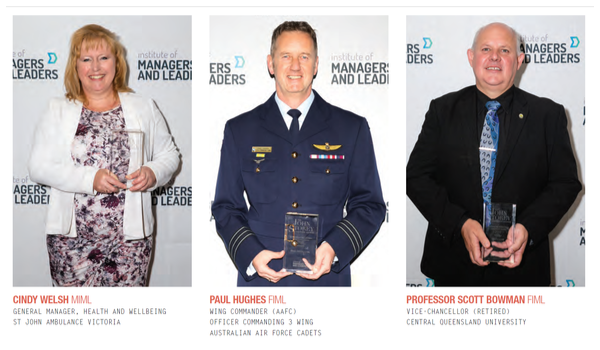
The mark of any great leader is to continue delivering the goods during times of uncertainty, pressure and flux. Leadership Matters caught up with three award-winning IML ANZ Members, who each lifted their teams’ spirits when the going got tough.


FACTORS THAT IMPACT MORALE

Plain sailing never lasts indefinitely, but the factors that can impact team morale are not always clear cut.

Cindy Welsh MIML, General Manager, Health and Wellbeing at St John Ambulance Victoria, says, “Morale can be impacted by things like corporate downsizing or gearing up for a new contract. Or poor morale may simply have been allowed to fester for some time.”

Paul Hughes FIML points to another way that morale can be sapped. Reflecting on his experience with the Australian Air Force Cadets, he explains, “One of the key reasons people join an organisation is because of its vision and its values. Any deviation from those values can impact morale.”

In Hughes’ case, the challenge of declining morale was the result of stagnation. He recalls, “When I came to 3 Wing (NSW and ACT) Australian Air Force Cadets, nothing had really happened for 10 years. People had lost their way and lost their sense of wanting to deliver an experience that our cadets deserved. There had been no growth, no innovation, and no real sense of direction and purpose.”


WATCH FOR WARNING SIGNS

In order to manage flagging morale, it’s necessary to recognise the warning signs.

Welsh explains, “A drop in morale can manifest itself through an increase in sick leave, higher staff turnover or poor performance. Or human resources personnel may be noting an increase in behavioural issues – perhaps more employees treating each other or their managers inappropriately. This can be a sign of underlying frustrations.”

She cautions that leaders and managers may ignore the warning signs because the company or department is performing well. Welsh notes, “This can be a sign of the ‘A-team’ syndrome, where competence and results are high. But they are not sustainable over the long term because people are unhappy.”


Welsh adds that business leaders don’t always pick up on how low morale has sunk. “They may ignore the warnings that their senior people have highlighted, or may base their opinion of staff morale purely on their own interactions within the workforce,” she says. “But not all staff are comfortable giving direct and frank feedback to the CEO or business leaders. It’s important to listen to your managers and, if you’ve been given consistent feedback, it needs to be explored.”


BE THERE. BE IN THE MOMENT

Leadership during challenging periods hinges on being visible. Welsh says there can be a “propensity to retreat from people during times of change”. But she adds, “Transparency with your employees is incredibly powerful. Don’t hide things from your staff.”

Welsh recommends, “Sit in the lunch room with your people and talk to them. Just listen. Hear people out. And do not underestimate the power of peer-to-peer influence. It can see low morale quickly spread throughout an organisation – even across different geographical locations.

“Think about how you can tap into influencers,” advises Welsh. “Use their powers for positivity, encouraging them to champion your change or cultural initiatives.”

Hughes suggests a similar approach, saying, “A lot of building morale as a leader involves being prepared to listen and see what you can do about the situation. Be prepared to take action on what people say – it’s not a matter of paying lip service.” He too recommends identifying ‘champions’, who will actively support your cause. “They will help to dispel the cynics,” says Hughes. “After all, peer pressure is the best pressure of all.”

BEING COMFORTABLE WITH FAILURE

There is no one-size-fits-all solution to lifting team spirit, and the approaches of the different leaders interviewed for this article proves the importance of a tailored strategy.

Professor Scott Bowman FIML, recently retired Vice-Chancellor of Central Queensland University, believes the social element of workplace teams can have a significant impact. He says, “It’s all about pulling together a group of people, who really get along well so that you have a team that celebrates shared successes and commiserates when things don’t go so well.”

He adds, “Leaders can organise events that allow everyone to take time out for reflection sessions. It’s important to look at what went right, and what went wrong. These are not just planning sessions, they are true reflection sessions.”

Professor Bowman notes, “It’s critical for these sessions to have a social element. I quickly worked out for example, that my team were all incredibly bad karaoke singers but they were all prepared to have a go.”

Perhaps surprisingly, Professor Bowman also highlights the importance of making mistakes. He explains, “It’s important for the team to be comfortable with failure. I’m a believer in the 70:30 rule, which says you can expect success 70% of the time and failure 30% of the time. If you have a failure rate below 30% you’re doing something wrong – you’re not trying enough new steps or strategies.”

Of course, the 70% of successes have to compensate for the 30% of failures but Professor Bowman notes, “The key is to pass this appetite for risk-taking down the line through your team. I was always open with my team about the 30% failure rate, and yes, it is unnerving for some people. However, it pays off when you achieve that 70% success rate.”

Welsh holds a similar view. “Foster a ‘no blame’ culture in the workplace,” she advises. “If people think they’ll lose their job because of a mistake, they will never speak up. Employees need to feel psychologically safe and comfortable about admitting to a mistake. Just as importantly, they need to understand what they could have done better and what they have learned from mistakes. Organisations that embrace continuous improvement and adaptive leadership will be the future game changers.”

The ability to accept mistakes extends to leaders also. Hughes notes, “You can collaborate until the cows come home, but ultimately decisions have to be taken. As a leader it’s about not being frightened to make tough decisions.”

Moreover, Hughes says it is important to be able to say, ‘You know what, we didn’t get it right, so what do we need to do now to change this to get the right result?’


HARNESS THE POWER OF PEER REWARDS

For Cindy Welsh, a simple recognition program was instrumental in lifting engagement and workplace morale. She says, “Managers can recognise individual staff, but at St John Ambulance Victoria we introduced the FISH! methodology, which sees peers recognise the efforts of each other.”

As Welsh tells it, prior to the introduction of the FISH! program, St John Ambulance Victoria had peer-to-peer engagement of 52%. Three years later, the program has boosted employee engagement to 95%.

Welsh says, “Thanking and acknowledging peers has now become part of our culture but it has taken time for this behaviour to resonate across the organisation. Increasing peer engagement is a slow burn.”


CREATE A BRAND OR LOGO FOR BONDING

For Paul Hughes, leading a volunteer organisation called for a different response. “We set about identifying how people were really feeling, digging deep into the issues at heart.”

He says, “We found there was no visual identity for the Wing – no branding or logo. So we developed a new logo as a visual identifier, one that best reflected the geographical area we served, which was NSW and the ACT.”

From here, Hughes helped to create a sense of purpose with the mantra ‘Setting the standard, leading the way’.

Hughes was mindful of including all stakeholders wherever possible. “By involving various stakeholders throughout the change process we were able to win over the hearts and minds of our people. This in itself became an integral part of boosting morale.” He adds, “It was about getting everyone on board the journey”.

The reward for Hughes has been a steady increase in the retention rates of cadets and staff over the past four years as well as increasing numbers of people wanting to join Australian Air Force Cadets.

With a keen eye for how your people are feeling, and some tailored strategies, it is possible to steer your team through challenging times.


This article originally appeared in the June 2019 edition of Leadership Matters, IML ANZ’s quarterly magazine.

The Info: Books on resilient leadership

By Sarah McDuling


When it comes to resilience in business, the simple truth is that it isn’t all that different from resilience outside business.

Resilience is defined by the ability to recover after a setback, to adapt quickly to change and persevere when faced with adversity. Learning how to view failures as opportunities, to remain calm in stressful situations, to build a supportive social network and take the time to clarify your goals… these are all important life skills that everyone should have both in their professional and personal lives.

The components that help make a person happy and successful in their personal life (self-assurance, life goals, friends) are the exact same components that help make people successful in business. For example, most strategies to build resilience in business tend to revolve around four key elements: Confidence, Purpose, Social Support and Adaptability.

When you consider those four key elements, it starts to become clear that in many ways, a ‘resilient’ person is really just an optimistic and emotionally stable person. Or in other words, a happy person. If you want to build your resilience, you need to work towards increasing your self-confidence and maintaining a positive outlook.

The reading list on this page contains an inspiring selection of books about resilience. Here you will find some of the best ‘how to’ guides, full of useful tips and strategies to help you build the skills you need to improve your business life, as well as your personal life.

Reading these books will help you develop skills to cope with a stressful work environment, manage time effectively, deal with sudden upheavals and adapt to change. Most importantly, these books will teach you the importance of looking after yourself so that you are better equipped to deal with whatever problems and setbacks may come your way.

When we hear the word ‘resilience’ we so often associate it with being strong, tough and determined. The books on this list will help you to understand that ‘resilience’ isn’t really about strength. It’s about emotional intelligence, positive thinking and self-care.

A resilient person is a happy person… so happy reading!


Books to inspire resilience

RESILIENCE BY HARVARD BUSINESS REVIEW

This book reveals the traits of those who emerge stronger from challenges. It also provides advice on training your brain to withstand the stresses of daily life and presents an approach to an effective career reboot.


DIGITAL RESILIENCE BY RAY ROTHROCK

This powerful guide provides the digital resilience-building strategies you need to prevail – no matter what strikes.


RESILIENCE AT WORK BY DEBORAH M KHOSHABA, SALVATORE R MADDI

Why do some people remain so calm and collected in the face of looming deadlines, combative meetings, impending layoffs, and turbulent changes? And why are these seemingly unflappable people the ones who consistently get ahead in their lives and their careers? This book provides the answers.


HOW TO BE HAPPY BY LIGGY WEBB

You can make the decision right now to be happier if you really want to be, says author Liggy Webb. Life is what you make it, she says, so learn how to be happy, effective and energetic.


OPTION B BY SHERYL SANDBERG, ADAM GRANT

From Facebook’s COO and Wharton’s top-rated professor, this powerful, inspiring, and practical book is about building resilience and moving forward after life’s inevitable setbacks.


FLY! BY RICHARD DE CRESPIGNY

In Fly!, Richard de Crespigny shares the insights and techniques he built up over decades in the high-pressure world of military and civilian aviation. Covering leadership, teamwork, risk assessment, decision-making, crisis management, lifelong resilience and more.


POSITIVE THINKING BY GILL HASSON

This book gives readers the tools to view life with a positive outlook and charge ahead in achieving goals that once seemed out of reach.


TRAIN THE BRAVE BY MARGIE WARRELL

Train the Brave is a handbook for being more courageous. Written for busy people on the go, its short, focused chapters provide practical tools and empowering perspectives to help you build your ‘courage muscles’ in work, relationships and life.


THE PURSUIT OF HAPPYNESS BY CHRIS GARDNER, QUINCY TROUPE

The astounding yet true rags-to-riches saga of a homeless father who raised and cared for his son on the mean streets of San Francisco and went on to become a crown prince of Wall Street.


Sarah McDuling is the Senior Content Producer for Booktopia and the Editor of the Booktopian Blog.

This article originally appeared in the June 2019 edition of Leadership Matters, IML ANZ’s quarterly magazine.

Managing the business vision

There’s no shortage of talk about strategy. But behind every good strategy, there must be a clear vision – after all, we all need a destination before mapping out our journey’s route. So, on top of managing the day-to-day and adjusting the strategy, how can leaders ensure they don’t neglect to manage the vision?

An organisation’s vision should be its North Star. It needs to be the aspiration that everyone strives to meet.  In other words, it needs to help managers think beyond the daily details and think ahead to the type of future they wish to achieve.

So essential is a leader’s vision that many CEO’s are either marked by their lack of it when they fail or they are exalted for it when they succeed.

At any stage of your leadership career, managing the vision and ensuring that it remains the guiding light is vital. So, here are three ways leaders can manage the organisation’s vision:


Align everything to your vision

The Golden Thread Model provides an excellent visual on how to practically align all activities to the organisation’s vision. It represents the link between vision, analysis, systems and people, amounting to a shared understanding of how the vision, goals and values of the organisation relate to daily work.

By using this model, leaders enable the development of clear metrics which align business goals with measures of success and ensures that individuals are aware of and accountable for their contribution. This makes it easier to drive business success as everyone in the organisation is heading in the same direction.


Motivate through the vision

In addition to drawing direct relationships between the vision, strategy and metrics for success the model also encourages the creation of team and individual objectives that tie back to the vision. This is important for maintaining lasting motivation. Unlike hitting targets, aiming to move the organisation closer to the vision takes incremental steps and the cooperation of all. That means your teams will aim to complete a marathon rather than running a sprint.

Leaders should, therefore, be conscious of providing their teams with an update on how their individual or team efforts bring the whole closer to its vision.


Tell compelling stories about the company’s future

The reality for leaders is that not everyone will be driven by metrics or inspired by stats. Vision-focused leaders appreciate the importance of shaping a powerful and compelling story of their companies’ futures. Beyond crafting an inspiring narrative, it also serves as a powerful engagement builder. Stories have the power to turn aspirations into reality – even if it’s just in the mind. That, in turn, gives employees the clarity they need to visualise something that often can be too abstract and feel out of reach.


Sources (these articles are available to IML ANZ members via Leadership Direct):

Why leaders should make time for strategic thinking

One of the most important remits of top leaders is the strategy. However, if 96% of leaders admit to not having the time to think strategically (as they are pulled into managing the day-to-day tasks), is it really as vital as most claim it to be?


Keeping strategy front of mind

An organisation’s strategy should never be treated as ‘set and forget’. Today’s business environment is engulfed in a constant stream of subtle discontinuities that may undermine an organisation if they aren’t watchful. Since these are unexpected and irregular, dealing with it requires being attuned to existing patterns, yet able to perceive important breaks in them.

Leaders must also guard against complacency. As success may trick you into becoming content, therefore risking the chance that you lose the edge and intensity that led you to the top.


That’s why leaders must make the time to seek out new opportunities, guard against looming threats and take advantage of untapped strengths. That’s why strategies should never be left static.

Although staying flexible in strategic terms doesn’t mean jumping from strategy to strategy. What it requires is continuous incorporation of new ideas to maintain the effectiveness and relevance of your strategy.


In Leadership Matters: 7 Skills of Very Successful Leaders, IML ANZ chief executive, David Pich walks leaders through the crucial skill of setting strategy. Here are three things we learn from Pich about why leaders require strategic thinking time:


1. To recognise when the strategy needs adjusting

According to Pich, successful leaders can detect when the strategy needs to be tweaked or changed. He warns, “there is a tendency for today’s leaders not only to believe that they have all the answers but to believe that these answers must be the right answers, every time.”

To fight against what Pich calls ‘strategic stubbornness’, it’s important for leaders to pause from time to time (and not just during the allocated ‘strategy day’) to gauge where the strategy is at and what adjustments must be made.


2. To involve others in strategic planning

Pich also cautions against setting strategy in a vacuum. He points out the need for buy-in from those who need to support and implement the strategy.

It’s imperative that leaders make time to meet with relevant stakeholders when assessing the fitness of the current strategy. Resist the temptation to go at it alone because that might be the quicker route. Involve others to ensure you receive the support you need to deliver the strategy.


3. To avoid feeling daunted

For Pich, setting strategy is the equivalent of eating the proverbial elephant. You need to cut it down to manageable chunks rather than trying to tackle it as a giant whole.

In his experience taking the helm at IML ANZ, Pich said, “We sliced and iced the big hairy elephant! Over the course of two full days (and with very significant pre-work), we arrived at what we called [IML ANZ’s] four strategic pillars.”

There are no shortcuts to a great strategy. Invest the time and keep checking in on yours to ensure that it sets you on the path to success.


Sources (these articles are available to IML ANZ members via Leadership Direct):

Finding the balance between getting things done and getting to know your people

By Shelley Flett


As leaders, we are influencers – and as influencers, we must encourage, enable and empower others to perform in a way that leads the business to success. We must do this while fostering a healthy workplace culture and to do it efficiently requires a different kind of balance. The most effective and successful leaders are those who can balance getting things done while nurturing their relationship with their people.

Take a look at Howard Schultz who is a great example of a leader who has perfected this balance. Schultz took charge of Starbucks in the 1980s and turned a regional coffee company into one of the world’s top brands. Howard’s net worth today is $4 billion so he’s clearly capable of getting things done and yet his focus has always been around people and building a company that “honours and respects the dignity of work and the dignity of all men and all women”.


Imbalance is the enemy

So why do so many leaders struggle to find this balance? Naturally, each of us have a preference of either getting things done or getting to know people and will gravitate to one or the other without giving it too much thought. And while both focuses are equally important, an over-focus in one area is often to the detriment of the other.

When a leader over-focuses on task and under-focuses on people it can result in:

  • Short term and unsustainable results driven by control, consequence or rewards (like overtime or bonuses)
  • Unrealistic pressure on the team and elevated stress on individuals which can increase absenteeism
  • Disengagement or the loss of trust by employees who may believe their leader doesn’t care
  • Impatience and frustration with conversations that aren’t task focused
  • Struggle for employees to connect with their leader who appears to be super-human with no weakness, vulnerability or fear of failing


Similarly, when a leader over-focuses on people and under-focuses on task it can result in:

  • A fear of upsetting others and therefore avoiding conflict or having vague conversations with implied consequences that are often misunderstood by employees
  • Saying yes and agreeing to unrealistic expectations – often to their own detriment
  • Being perceived as ‘soft’ or not serious about delivering results
  • Taking too much responsibility and justifying poor performance with peers and senior leaders


Why finding the balance matters

When a leader can get the balance right and pay just as much attention to getting things done as they do to getting to know their people, they will:

  • Create deeper trust and stronger relationships – regardless of the current challenges
  • Communicate and consistently manage expectations of what success looks like for both the individual and the business
  • Experience more open and transparent conversations, robust debate, challenging of ideas and innovative thinking
  • Gain greater respect for differing perspectives and encourage curiosity about alternative ways of working
  • Empower others to make decisions – including where, when and how work is performed


Creating the balance between task and people starts with awareness, of your own preference, and then consciously shifting your focus evenly across task and people.

Once you find this balance it’s not something you unlearn or forget – it becomes your way of leading and even your way of living.

In Schultz’s departure message to employees, he maintained the balance between task and people, writing “success is not an entitlement; it must be earned every day through hard work and teamwork. Try to listen with empathy, respond with kindness, and do your best to perform through the lens of humanity”.

When a leader can generate a culture of accountability and deep trusting relationships then they move to a position of influence!


Shelley Flett is an expert in leadership development and team performance, with more than a decade of experience in operations and call centres across banking and telecommunications. She is focused on maximising efficiency and building high performance team cultures. Shelley is the Author of ‘The Dynamic Leader: Become the leader others are inspired to follow’ (Major Street Publishing RRP $29.95). For more information visit www.shelleyflett.com.

How does organisational culture shape your brand

Brands are much more than a name or symbol of a product. Leadership and people-management specialist and author, Karen Gately, believes that in a highly competitive world with the pressure on many organisations to lift their game intensifying, leaders are wise to define brand more broadly as the reputation that underpins consumer confidence and inspires buying decisions.

So how does organisational culture fit into this definition? Gately defines culture as the way things are done within an organisation. However, she cautions against believing that organisational cultures exist in a vacuum. “It’s entirely possible for an organisation to be confronted with behaviours from within their ranks, that are not reflective of culture. Once off, exceptions to the rule while problematic are not reason alone to ring the culture alarm bell.”

Gately knows that there are many examples of organisations who have failed spectacularly in maintaining trust in their brand because of a profit-centric culture. “Findings of the banking royal commission provides endless examples of a lack of integrity and poor behaviour,” she says.

“It’s evident the issues exposed were far from isolated incidents of poor decision making or selfish actions on the part of random individuals. In many instances, these behaviours were instructed, encouraged and rewarded by the organisations they worked for.”

As we’ve seen post-royal commission, distrust damages brands.

So how can leaders shape a culture that makes a positive influence on your brand? Gately lists three ways:


Set clear expectations around employee behaviours

Creating a powerful brand through people starts with being clear about what is expected and needed.  Leaders are wise to invest in ensuring every person on the team understands what successful behaviours look like. In other words, ensure a clear line of sight between how people go about their jobs and the influence that has on brand reputation.


Understand the touch points between your business and customers

Build understanding of the touch points between your customers and business, and the opportunities people have to influence trust and loyalty. Create awareness of the ways in which behaviour influences not only what people think, but also their subconscious reactions to your brand in the future.  Reflect on for yourself on when you have held an opinion about an organisations brand but have struggled to identify exactly why you feel the way you do.  Sometimes people don’t even bother to work out the answer. They simply move on to a brand they feel better about.


Get your hiring process right

Creating a great culture is unquestionably influenced by the quality of hiring practices. Getting it right from the start requires a disciplined and uncompromising approach to selecting people who are aligned with the organisation’s values. From there what matters most is that people are held accountable for the standard of behaviour they bring, and influence they have on your organisations brand.  Reward and recognise brand ambassadors and take decisive steps to address the attitudes and behaviours of those who are not.


Karen Gately, founder of Corporate Dojo, is a leadership and people-management specialist.  Karen works with leaders and HR teams to drive business results through the talent and energy of people. She is the author of The People Manager’s Toolkit: A Practical Guide to Getting the Best From People (Wiley) and The Corporate Dojo: Driving Extraordinary Results Through Spirited People.

Thinking bigger for business development

By Adrienne McLean MIML

Thinking bigger about what your business offers to customers can propel the business into areas of growth never imaged. It also keeps the business relevant, agile and in step with changing market forces locally and internationally.

But if something isn’t broken you don’t fix it, right? Sticking to the same way may seem reproducible and efficient, but is it limiting your business? While being able to offer a service or product well is of course good business, remaining stagnant in the way you do things means business efficiency could suffer. If you think of a wheel, it fundamentally hasn’t changed but its features have adapted to suit the needs of today’s modern vehicles.

It’s worth asking if there are new markets your business can go into. Or could you offer new products to your current market?

The business development process may simply involve implementing a culture of continuous improvement or it may require you to look for the next big growth step. Whichever stage the business is in, these five steps are important for thinking bigger about the business and focusing on what the business is offering customers and prospects.

1. Innovate

Coming up with new approaches and better delivery of the service/product to the customer are the driving forces for innovation and growth. Awareness of what is happening in the industry and the market is also essential. If you don’t keep track of these, beware – other companies certainly do and they can overtake you.

Thinking bigger about your business offerings drives innovation. Wanting to be the best, wanting to offer a brilliant service, wanting to reach more clients than ever thought possible – all these mindsets will help drive the innovation your business needs for business development.

2. Plan

Boldness and aiming high will get the business out of its comfort zone and propel it forward. However, change and improvement require more than just new ideas and aspirations – you must support it with a plan. Set goals against implementation timeframes. Whether these are long- or short-term periods will all depend on the size of the change and what you are trying to achieve.

Set down a pathway for growth that involves everyone in the business – from management to staff. Inform everyone of their involvement in the change to ensure a smooth process.

3. Set goals

This is about setting your focus and involves the following steps:

  • Set SMART goals – Specific, Measurable, Actionable, Realistic and Timebound
  • Keep goals easy to see as reminders
  • Check in daily and weekly to track whether you’re on target
  • Celebrate when tasks are completed, and goals are achieved
  • Reset to goals that will stretch you and the business further

4. Collaborate

Constantly search for strategic partners who can help you in the pursuit of your aspirations. You may (or may not) currently do business with them but always keep an eye out for those who can help you get where you want to go.

Building collaborations will also help with secure referral partners and affiliate marketing – therefore growing your connections and the opportunities to get your message out there.

5. Measure

Measurement is pivotal as it keeps the business honest. Select metrics that are relevant to your goals and what you are trying to achieve.

You can measure several metrics including:

  • Financial: Measure the impact on the profit and loss or cash flow statements
  • Sales and marketing: Track the number of leads in pipeline, website views or sales calls against acquisitions
  • People and teams: Set metrics to measure not only what your people are achieving but also if they remain motivated

Thinking bigger is a mindset of growth and development about your business offering. It’s the way to build the business and achieve your aspirations. Focusing actively in on innovation, planning, setting goals, collaborations and measurement will propel business development on a successful pathway.

Do an audit on your business and check where you are at with each of these five steps. This will highlight steps for the business to think bigger and look at growth strategies.


Adrienne McLean is the founder and principal marketing and speaking coach for The Speaker’s Practice – which runs workshops, coaching and events that help professionals to improve their marketing and communications.

IML ANZ Members in Sydney are invited to join Adrienne at the Professional Services Marketing Conference on August 17th, 2019. This information conference takes delegates on the business development journey starting with marketing and digital marketing, going through to sales topics with mindset topics covered throughout the day. IML ANZ Members who book by July 17th enjoy a 15% discount when they use the code IMLEB. To book or find out more, visit www.professional-services-marketing-conference.com.

Career Doctor: Why is coaching and mentoring so important?

By Peter Cullen FIML

One of the greatest privileges and sources of satisfaction for a manager is to become a coach or mentor. It’s always a privilege to have someone demonstrate their trust in you and there’s nothing more satisfying than witnessing someone achieve a desired outcome. It can have a profound impact on the individual, the manager and the organisation.

Often coaching and mentoring are mistaken for being the same thing with a different name. They are in fact, very different.


COACHING

When is it coaching?

Coaching is typically provided by an immediate manager to help people develop competencies, new skills and self-awareness. It also assists in improving performance and equips the coachee for new responsibilities and professional development. Importantly, it is 100% coachee-focused, open and honest. When coaching, the coachee must think of potential alternatives, determine solutions, confirm goals and take ownership, responsibility and accountability for outcomes. On the coach’s side, you spend around 80% of the time listening and 20% asking open, probing and expansive questions to stimulate the coachee to develop and confirm their next steps.

What is a good coaching model?

A very simple and popular model for coaching is GROW: goal, reality, options and wrap up. Goal is the agreement on the specific objective of the conversation. Reality is the discussion around your past and current state. Options involves creatively thinking about potential solutions. Finally, wrap up confirms the best solution set against a plan that includes follow-ups and timing of completion stages. Although GROW appears linear, you may find the need to move backwards and forwards between the steps as more information is provided.

Can coaching be informal?

While coaching can be formal or informal, following a structure leads to lasting results. For instance, if a direct report often comes to you with a problem and you happily provide a solution, that’s informal coaching. Being time poor, you might feel satisfied that you were able to provide a quick solution. Unfortunately, you are also teaching this person to come to you for answers instead of thinking for themselves. This is an ideal situation for the quick and effective use of GROW. You may also use GROW formally during performance discussions, professional development or when helping team members consider potential career aspirations.


MENTORING

When is it mentoring?

One difference between coaching and mentoring relates to who mentors you. Unlike coaching, a mentor is typically someone you do not report to or know, is several positions more senior and has broader experiences and knowledge in your field. It is important to have a safe, trusting and confidential environment knowing you can speak openly about your concerns and desires. Many companies also provide mentoring programs that give you access to mentors in other organisations or you can source one through colleagues, networks and business associations. Details of IML ANZ’s mentoring program can be found at managersandleaders.com.au/mentoring-program

What makes a good mentor?

Good mentors ensure the relationship is goal-oriented, focused on you and have your best interest at heart. They will happily share wisdom gained from their personal and professional experiences and guide you to build capability in areas that match your goals. The very best mentors will invite you to reshape your thinking and consider the bigger picture as part of their commitment to help you.

Coaching and mentoring are vital and valuable skills that add a great deal of depth to your role as manager. It allows you to develop individual and team capability while nurturing an open and honest environment built on a foundation of trust. Importantly, acquiring and using these skills not only benefits the coachee but increases your value as an asset to the business.


Peter Cullen is an education and training facilitator. He conducts three-day programs that engage participants in developing and implementing their capabilities as managers and leaders.

This article originally appeared in the February 2019 edition of Leadership Matters, IML ANZ’s quarterly magazine.