5 ways it pays to be a member

Could a professional network be the answer you’re looking for?

Not everyone is a ‘joiner’ – in fact, some people even dread the idea of talking to strangers at professional events! But no matter what industry you work in, networking is almost inevitably something you’ll need to do at some point. The good news? By tapping into a network of like-minded career people, you may gain a lot more than you expect. Whether you’re an aspiring entrepreneur or a well-established manager, joining a professional membership organisation can be a great way to connect with people you’d never otherwise meet, and gain unexpected benefits.

We asked a few of the Institute’s Members what motivated them to first join up, and why they benefited from being part of the IML ANZ community. Here are a few of their answers – if you can relate to any of these, perhaps it’s worth signing up for a professional association!

1. When you want to get to the top, pronto.

If you have clear career goals in your sights, and you want to achieve them as quickly as possible, then it’ll certainly pay to put yourself out there. By joining a membership organisation, you’ll have plenty of opportunities to do just that – whether it’s by attending events, connecting online, or contributing content to a blog or LinkedIn. Building a professional profile is especially important when you’re first establishing your career (or when you are trying to establish yourself as an expert in a field or on a topic). After all, no matter what business you’re in, it helps to meet people you wouldn’t cross paths with in the office kitchen – broadening your perspective, opening up potential job opportunities down the track or seeking out business development opportunities. As the old adage goes, “sometimes it’s who you know, not what you know.”

2. When you’re running a business, and feeling a little isolated.

Running your own show has many perks: freedom and flexibility for a start. But while it’s exciting, the life of an entrepreneur can also be a lonely one – and you may find yourself missing those small human interactions you once took for granted in a bigger office. This is where being a Member of an organisation like IML ANZ can make all the difference. Not only do you have events to look forward to, you can even take advantage of Member lounges – a great alternative to working from home! Not only is it nice to bump into new people on a social level, it can open up new doors professionally too. Who knows, maybe that nice person sitting beside you is your next big client?

3. When you’ve reached a career plateau, and aren’t sure what’s next.

When you’ve been working in the same industry for a while, a time might come when you hit a wall. You’re not sure how to progress, or what direction to move in – and chances are, there will be a limit to how much people in your existing organisation can help you. If you’re in this particular boat, it can really help to take a step back and talk to people outside your immediate orbit – and of course, joining a professional community is an easy way to find them.

Seeking advice from people with different perspectives can help you see your own situation more clearly, and it could even inspire you to make a career change you’d never previously considered. You might have a light bulb moment attending one of our Masterclasses. Otherwise a lot of our Members find the reading material provided (like the quarterly magazine, Leadership Matters) very useful, as it’s designed to provoke thought and spark new ideas.

Or if you really want to stand out, IML ANZ is also the only organisation to offer the Chartered Manager accreditation: an internationally recognised designation that can really set you apart.

4. When you’ve got a dilemma you’re not sure how to solve.

While it’s easy to ask for help when you’re starting out in your career, it can become harder as you rise up through the ranks of management. Not only will there be fewer people around who are more senior than you, there can be politics that prevent you from wanting to seek their help. That said, no matter how experienced you are, there will be moments when you need a second opinion – maybe you have a tricky employee to manage, or maybe you’ve lost touch with what’s considered best practice in your sector.

This is certainly a time when a membership organisation like IML ANZ can help. As well as connecting you with valuable learning resources (including videos, articles, e-books and research), the Institute can also put you in touch with people who’ve ‘been there, done that’ – peers who can provide guidance without any strings attached. Because, no matter what level you’re at, leadership is a skill that you never stop learning.

You also have the chance to find a mentor to give you personal guidance – which is a serious advantage in our competitive job market. It might be just the circuit breaker you need!

But mentoring isn’t just for those who are seeking guidance…

5. When you’ve reached a point where you’d like to give back.

Chances are, you won’t have reached your current level of success without the help of at least one or two people. If you were really lucky you may have even had a mentor who shared their advice and knowledge at critical points in your career. What’s important to remember is that these relationships aren’t just valuable for the mentees – they’re also very satisfying for the mentors. If you’re at a stage in your career where you have valuable wisdom and life lessons to share, why not give back by becoming a mentor? Doing so through a membership organisation means you can make a real contribution to your industry. You might even find yourself learning a thing or two from the people you mentor – and at the very least, you’ll gain fresh insight into topics you thought you knew back to front.

Curious about how IML ANZ Membership works, and what it costs? Click here to check out more about our professional community.

Accreditation: The secret to a successful transition

Humans are hardwired to resist uncertainty. It’s no wonder change can be daunting even for some of the most resilient people – those in the defence force.

Paul Hughes CMgr FIML

In 2018, the Department of Defence released the Transition Taskforce report, that estimates around 5,500 to 6,000 members of the defence force leave active service annually. That means thousands of men and women make a life-changing transition every year.

The same report reveals that a significant barrier to an effective transition is feeling unprepared, or ill-equipped to manage the differences between the military and civilian environments.

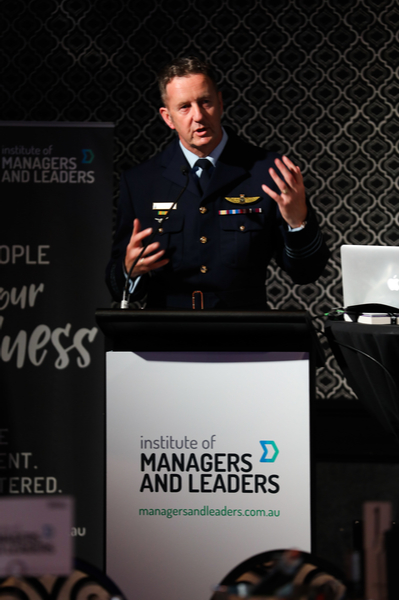
It’s a common feeling. “There’s always that fear, I know I felt it when I made the change when I left the Royal Air Force,” recalls Paul Hughes CMgr FIML, former Officer Commanding 3 Wing Australian Air Force Cadets and now a client relationship manager for Converge International, one of the largest employee assistance providers in Australia.

“I think it’s because it’s perceived as two different worlds, the military and the ‘civvy’ (civilian) world. But they’re more similar than what people imagine.”

Minding the gap

And where there are differences in these two worlds, it seems veterans simply need to validate the skills they already gained in service.
That’s what Ben Urquhart CMgr AFIML, a communications electronic technician for the RAAF who later secured leadership roles at Saab Australia, Ultra Electronics and Kongsberg Defence Australia, discovered.

Ben Urquhart CMgr AFIML

“One of the challenges coming out of service was that I didn’t know how to talk to civilians,” says Urquhart. Not that he lacked communication skills, but he had to adjust his style to suit a new audience – one that didn’t have the military mindset. Urquhart points out that it was “the communication skills to motivate people,” that he crucially needed.

Urquhart looked towards leadership skills development to close that gap and completed a diploma course. However, he reached a stage in his career where classes just weren’t enough. “I considered doing an engineering degree but quickly realised that I wanted to stand out for my management and leadership skills, not my technical skills,” says Urquhart. So Urquhart applied to become a Chartered Manager, the highest accreditation available for managers and leaders.

Hughes believes this is a vital step for those wanting to validate their skills as they exit the defence force. “Accrediting your skills is a key move. It’s about realising your worth and value, knowing what you can bring to the table and getting formal recognition for it,” says Hughes.

Three tips on making a successful transition

Both Urquhart and Hughes believe that there are many practical steps to take if you want to make a successful career transition into the civilian workplace.

  • Network with non-military professionals. Urquhart has thoroughly enjoyed networking with leaders from different industries as a member of the Institute of Managers and Leaders Australia and New Zealand (IML ANZ). It has opened his mind to the way others have achieved success. Plus, the Transition Taskforce report lists establishing new networks as one of the ways to enable a successful transition into civilian life.
  • Accredit your skills. Neither Hughes nor Urquhart completed a degree, but that didn’t stop them from becoming successful and respected leaders. Hughes believes that by obtaining a designation, such as Chartered Manager, you gain clarity on your professional ‘mission’. It helps you become a leader who continually develops their knowledge and competence while empowering you to make a positive impact on others.
  • Build up your courage. Hughes observes that the military provides its people with excellent leadership skills training. So veterans often enter the non-military world already equipped with sought-after leadership skills. Formal recognition of those skills can give you the courage you need to back yourself. Remember, to foil fear you need courage.

The business world needs better leaders

Find out how you can accredit your leadership skills and gain confidence and courage. Take the Chartered Manager eligibility quiz now.

Why soft skills are today’s most valuable leadership asset

By Greg Smith

Soft skills have long been a desired leadership capability. However, in an age where rapid advances in technology are redefining how humans add value in the workplace, soft skills will increasingly become the most sought after employee capability possibly eclipsing everything else. Our current situation with the COVID-19 pandemic has thrust us into the new reality right now. And that’s just the beginning. Deloitte’s 2019 study, The path to prosperity. Why the future of work is human, predicts that by 2030 around two-thirds of jobs will be ‘soft-skill intensive’.

Sometimes when change is so rapid, it can feel like a high-speed train bearing down, and the immediate inclination is to jump out of the way. However, the best response is to understand, embrace and run with it!

Let’s see what that practically means when it comes to soft skills and the workplace.

“My boss has terrible interpersonal skills.”

How many times have you overheard one person saying this to another: “My boss is really great technically but has terrible interpersonal skills.”?  This is still a major deficit for some leaders and continues to frustrate the growth and progress of individuals, teams and entire organisations.

Leadership development programs, for some time now, have sought to improve leaders’ ability to better connect with others. However, this remains an elusive skill for many. Dial up the need for this capability many times over, and it doesn’t require much of a stretch of the imagination to see why this will become an absolute requisite and priority for effective leadership.

The notion of soft skills also implies the existence of hard skills. So what are soft skills, and how are they different from hard skills? Let’s first take a look at the sources of soft skills. These are found in personality traits, personal attributes and specific behavioural competencies. Hard skills, on the other hand, are developed through training and learning. It’s easy to see from this comparison why the nature of soft skills makes them much more difficult to impart to others than hard skills! The exciting aspect of soft skills is that they are highly transferable, which in a fast-changing employment landscape driven by technological change, makes them an extremely valuable asset and powerful differentiator when competing for jobs.

Why EQ matters

Fortunately, the concept of Emotional Intelligence (EQ) harnesses the key suite of soft skill capabilities required by leaders and their followers alike. Simply put, EQ may be thought of as not letting your emotions stop you achieving your goals. Although this descriptor neatly packages up EQ into a simple and easy to grasp idea; it doesn’t help with understanding how to develop and enhance your EQ capability.

Daniel Goleman described EQ competencies as “how leaders handle themselves and their relationships” in his book, The New Leaders.  He explains EQ competencies in two domains:

  • Personal competence: Self-Awareness and Self-Management
  • Social competence: Social Awareness and Relationship Management

It’s immediately apparent that EQ competencies cannot be ‘codified’ or automated and therefore replicated by AI or machines, making them solely the domain of human beings. However, if AI and machines take over routine tasks (e.g. technical support, bricklayers or administration) then non-routine roles (e.g. social workers, emergency workers, teachers or chief executives) become a natural place for humans to gravitate towards, an essential transition for secure employment in the longer term. 

Three navigation steps for the workplace

There are three key steps to navigate and take advantage of the wide array of exciting roles that will open up as a result of technological change. These are:

Step 1: understand and internalise the new reality of the transition that’s afoot showing where human beings will add value in the workplace of the future. It’s just around the corner, so it’s worthwhile considering how this may impact your career in terms of risks but more importantly opportunities.

Step 2: reflect on where and how you add value now in your current work role.

Step 3: identify your transferrable skills and consider how you might align these to the jobs of the future. This includes exploring what further training and development you may need to optimise these skills fully.

Start preparing now!

It’s highly likely that you could be drawing on soft skills to drive your future career even if you don’t use or need these skills in your job right now. My advice is to start preparing now for the future that lies ahead. The future is sure to be full of boundless possibilities as new jobs unfold that have not yet been invented or even conceived!


Greg Smith is an expert in career development, talent management and organisational leadership. He is the author of Career Conversations: How to get the best from your talent pool (Wiley).

MEMBER EXCHANGE – Successful careers through solid planning

Gone are the days when careers meant moving straight up a ladder. These days, career paths have become more like a lattice – you might take steps upwards, sideways or even downwards.

That’s what makes career planning a crucial step in managing your learning and development. Regardless of where you are in your career, it’s useful to explore the path that you’re on. By developing new knowledge and skills, you’ll be well equipped to move into that new opportunity, no matter where it is on your career lattice.

Think of career planning as a continuous process of:

  • Reflecting on your interests, values, skills and preferences
  • Exploring the life, work and learning options available to you
  • Ensuring that your work fits with your personal circumstances
  • Fine-tuning your work and learning plans to help you manage changes in life and work

You can revisit and use this process at any stage of your career.

Start at the step that is most relevant for you now.

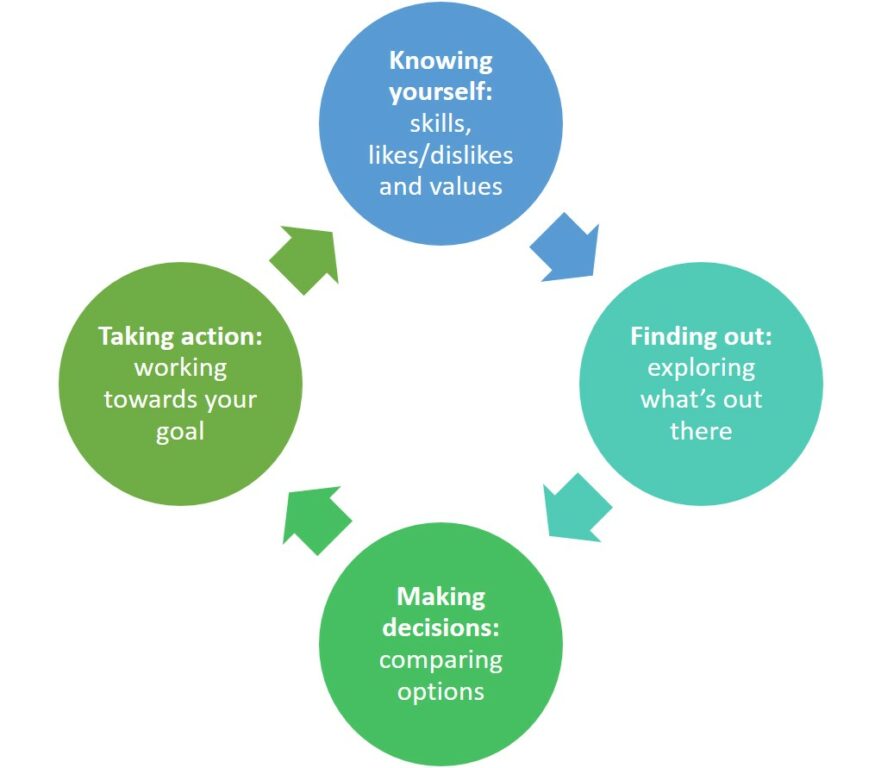
Planning cycle

The career planning process has four fundamental steps:

Step 1: knowing yourself

Step 2: finding out

Step 3: making decisions

Step 4: taking action

Let’s take a look at each step.

Step 1: knowing yourself

Ask yourself:

  • Where am I at in knowledge and skills now?
  • What do I want out of a job or career?
  • What do I like to do?
  • What are my strengths?
  • What is important to me?
  • Where do I want to be?
  • How will I get there?

After this, you can work on getting to know your skills, interests and values.

At the end of this step, you will have a clearer idea of your work or learning goal and your individual preferences.

The SWOT analysis in Article 1 can also be of great use to you at this point. You can use this information about yourself like your personal ‘wish list’ against which you can compare all the information you gather in the next step: finding out. Your personal preferences are very useful for helping you choose your current best option, which you can do in Step 3: making decisions.

Step 2: finding out

This step is about exploring the roles and learning areas that interest you. Once you have some idea of your job preferences you can research the specific skills and qualifications required in those professions.

  • Explore. Ask people around you about their roles, how they achieved success in their career. This mentoring program is an excellent forum for learning about others’ stories how they built their career.
  • Identify. Pick out roles that interest you. Assess whether your skills and interests match up with the job’s requirements. Do you have skills that are transferrable for this particular role or profession?
  • Develop. Taking on projects in your current workplace is a great way to close any knowledge and skills gaps to further your career journey. Also, look at developing skills outside of work. Sporting, community and charity groups always need people with a vast range of skills.
  • Locate. Do research not just on careers but on companies who you think you’d like to work with and where your interests and values align. Find out where your preferred roles are on offer.

At the end of this step you will have a list of preferred roles, companies you’d like to work with and opportunities for further learning.

Step 3: making decisions

This step involves comparing your options, narrowing down your choices and thinking about what currently suits you best.

Ask yourself:

  • What are my best work or training options? How will these currently impact on my work and life situation? How long will it take to get appropriate knowledge or qualifications and how do I manage my career in the meantime?
  • How do they match with my skills, interests and values?
  • How do they fit with the current labour market? What’s happening in the economy and politically? Is there opportunity for career growth within my current organisation or region?
  • How do they fit with my current situation and responsibilities?
  • What are the advantages and disadvantages of each option?
  • What will help and what will hinder me?
  • What can I do about it?

At the end of this step you will have narrowed down your options and have more of an idea of what you need to do next to help you achieve your goals. We would recommend that you use the Kolb Action Learning model in your Mentoring Resource book. This will provide an excellent tool to assist you at this stage of planning.

Step 4: taking action

Here you plan the steps you need to take.

Use all you have learnt about your skills, interests and values together with the information you have gathered about the world of work to create your plan.

Begin by asking yourself:

  • What steps will help me achieve my work, training and career goals?
  • Where can I get help?
  • Who will support me? Who can give me a reality check about my choice at this stage? What might be some of the barriers moving forward and how will I overcome them?

At the end of this step you will have:

  • A plan to help you explore your options further (work experience, work shadowing or more research); or
  • A plan which sets out the steps to help you achieve your next learning or work goal
  • Decide which step is relevant for you right now and start from there.

In all of this you need to remember that your career doesn’t happen in isolation to other aspects of your life.

As you work your way through the model ensure that you’re taking your entire life circumstance into any decisions you make.

Real rest: Switch off from work and feel good

By Jane Caro

We live in an era that worships work. Far too many of us believe that unless we are actively doing something every waking moment, we are wasting time. Many people feel guilty about scrolling aimlessly through social media, whiling away an afternoon (or even a whole day) binging on a TV series and/or nodding off on the couch.

I am not one of those people. We all have our gifts and my ability to be completely idle without guilt is one I value dearly.

Such is our worship of work that we even turn attempts to relax into a form of pressure. Wellbeing, mindfulness, meditation (yes, yes, I know they benefit many) are far too worthy and earnest for me. I don’t want to be lazy and do nothing because it’s good for me (even though it is). I want to do it because I like it and my joy in skiving off is actually enhanced by a messy house, laundry that needs doing or dishes that need washing.

SLAVE DRIVER

Perhaps this is also because I work for myself and I have never had a more demanding boss. She (me) is always taking on more work, agreeing to impossible deadlines and working on weekends. She says yes to far too much. Some of it unpaid! This slave-driver (me) is the reason I feel entitled to rebel against her (myself) on a regular basis and collapse on the couch, Netflix remote in hand and give myself over to blissful self-indulgence.

If you run a small business or work as a freelancer or subcontractor, you will know how hard it is to carve out a little time for yourself. If you are not actively working, you are accounting for that work, taking care of the inevitable admin tasks or you are actively seeking more work. It is hard to escape the nagging sense of guilt whenever you’re not actively engaged. But, take it from me, it is necessary both for you and your business. Let’s not even mention your family.

Recreation is a word that we no longer understand. It literally tells you to re-create yourself through activities – or lack thereof – that have no purpose but fun. It is no accident that creativity is part of the word. If you work till exhaustion, if you haul yourself miserably through every day or even most days, your productivity will fall. You are not at your best. Your heart is no longer in it. You’ve lost sight of why you started your business in the first place.

LOVE WHAT YOU DO

Every successful small business has one important similarity – a principal who loves what they do. Now, that doesn’t mean you have to love it every day, or love every task, or even every customer, but you have to love what you do and what you provide – at least most of the time. The paradox of hard work is that you can have too much of a good thing. If you lose your joy in your business for too long, you are at risk of eventually losing your business. When you lose joy, you lose creativity and the ability to come up with new solutions.

We have an epidemic of anxiety in our modern world, brought on for many, I believe, by overwork. Exhaustion is a result of working too hard for too long with no emotional reward. Exhaustion is useful to those who would control our world. Exhausted people, terrified of losing their income if they take so much as a holiday, are compliant people. It’s not just their businesses that become plodding and uninspired, it is their citizenship, their family lives and their view of the future. And, I know this is modern-day heresy, but I believe that if everyone worked 30% less, everything would improve. We’d be more joyful, rested, fun-loving, hopeful, generous, energetic and creative.

I know this is modern-day heresy, but I believe that if everyone worked 30% less, everything would improve.

Maybe the essential paradox of running your own business is that it may be the time when you let yourself lollygag, laze about, daydream and, yes, scroll aimlessly through social media, that is when you are able to have your best ideas and come up with solutions that all the agonising and late nights in the world will not liberate. You will also model sane behaviour to your employees so they too learn the value of rest and recreation, and so become more productive and enthusiastic. It isn’t the hours you put in that are of the greatest value. It may well be the hours you take out.


This article originally appeared in the December 2019 print edition of Leadership Matters, IML ANZ’s exclusive Member’s magazine. For editorial suggestions and enquiries, please contact karyl.estrella@managersandleaders.com.au.

One of the greatest engineers in Australia

We trust engineers to design the structures that run our world. For one of the best engineers in our country, his profession is all about building a career that empowered others.

IML ANZ is tremendously proud that one of our members, Errol Milevskiy CMgr FIML, has been named one of the 100 great leaders in Australian engineering history. Milevskiy joins other notable names in the profession in Engineers Australia’s 2019 centenary book, Anything is possible – 100 Australian Engineering Leaders. These 100 leaders were nominated by their peers and include the most highly respected engineers in history.

Notably, Errol is one of the only 32 living engineering leaders in this centenary book, as well as the only marine engineer, marine surveyor or engineering technologist to be recognised among the 100 individuals.

Humble beginnings

Milevskiy’s life wasn’t always about being recognised for greatness. He has faced challenges too. As a baby he received the last rites and as a teenager lost both his parents. As if not tested enough, the North Queensland country local has suffered from the chronic pain condition Trigeminal Neuralgia, an illness with no cure, for the past 18 years.

His working life began as a labourer at the local sugar mill, which soon evolved into an apprenticeship as a fitter and turner. Yet Milevskiy has not merely endured. He has thrived, becoming one of the leading worldwide marine engineers and surveyors, and preventing serious casualties and disasters through his focus on the details critical to marine surveying.

A career anchored on leadership development

Milevskiy’s potential was recognised by BHP, who offered him a cadetship as a marine engineer. After that, he attended some of the most prestigious universities, including Harvard and MIT.

In the late 1990s he produced his prize-winning thesis, ‘Building a Foundation for a Marine Engineer’. Milevskiy wrote it as a guiding tool for cadet engineers to build practical knowledge and techniques, not generally covered in textbooks.

Joining DNV GL, an international classification society, as a marine surveyor and station manager in Newcastle rounded out his skill base. This included surveying different types of ships, certifying numerous machinery parts and systems and being the attending surveyor for the topside construction of ESSO oil platforms.

Later, he commenced auditing to certify vessels and companies to the International Safety Management code from the International Maritime Organisation. He soon became dockyard manager at the largest commercial dockyard in the southern hemisphere. By this time, he was already regarded as one of the world’s most highly qualified surveyors.

Milevskiy continued critical, sometimes dangerous surveying work, notably identifying significant safety and structural issues on an Australian crude oil tanker in 2003. Thus averting potential loss of the vessel, human life, and catastrophic environmental damage. In recognition of his expertise, he was appointed as a member of the elite group of only 20 worldwide surveyors in 2009, named the ‘Flying Squad’, tasked with handling demanding situations on vessels internationally.

A fellow at four different institutes, including IML ANZ,  Milevskiy is also a Chartered Manager. Since 2014, he has mentored future leaders and managers through IML ANZ’s Member Exchange program.

The quiet achiever is pleased to have contributed to the improvement of the engineering profession – and leadership in our country.

Take Two: A mentoring pair on the same page

By Lisa Calautti

When marketing manager Emma Tune MIML decided to seek a mentor, IML ANZ teamed her up with business advisor Sarah Hunter FIML. It turned out to be the perfect match.


Why did you decide to join the Member Exchange program?

Sarah Hunter: Mentoring is something I do quite a bit anyway. It is definitely a giving back exercise. I enjoy helping people who are at an earlier career stage to jump ahead – you think of all the things you know now, that you wish you had known 10 or 20 years ago.

Emma Tune: I have always been fortunate in having managers and colleagues who have been generous in sharing their time, knowledge and skills with me. But I didn’t have anyone within the business who had a marketing background. Things have changed so much in marketing in the time I have been in my role, so I sought the opportunity to learn from someone with that background and experience.


How would you describe the experience of being part of Member Exchange?

SH: Very good. In fact, at our first meeting we were quite overcome by how well matched we had been. We just clicked right from the beginning and it was clear that what Emma needed, and what I had, were extremely well aligned.

ET: We were so well matched. There were so many similarities in my role and Sarah’s experience. We talked the same language.


What did you gain from the program?

SH: A bit of clarity of thought. I had to put myself in some circumstances and try not to see things from my perspective or through my own lens. That wasn’t too hard because I was not making decisions, setting direction or giving instructions; just listening and offering reading material or an avenue to follow, then letting Emma do it herself. I had the satisfaction of seeing someone grow and develop, knowing some of the things I had put in front of her were helping her do that.

ET: Sarah was great at recommending resources and frameworks for the different situations and challenges that I had. We talked about many aspects of my role and having an outside perspective helped me to reframe the issues in many cases. Sarah was great at challenging my thinking in a constructive way. Overall I learned that in almost all cases it comes down to people and process. Having recommended resources to use also gave me something tangible I could work with.

One of the key areas that kept coming up was the importance of people management. In my head I already knew this but, through our discussions, I realised there is so much more to it than just managing a team of people. In business it is important to manage relationships at all levels across the business. Another key learning was that seeing the business from an outside perspective makes you look at the bigger picture, which is so important, but hard when you get caught up in the busy day to day.


What motivated you to be involved in Member Exchange?

SH: Definitely giving back, and being someone who can help build confidence. Emma taught me that really everything is all about people. No matter what business, industry or stage of life, it all goes back to being about people.

ET: I enjoy learning from people and seeing different perspectives. It had been many years since I had taken part in a formal mentoring program and thought it was the right time for the stage I was at in my career.


Would you recommend the program to others?

SH: Yes, I recommend people get involved in mentoring as it is an opportunity to look at things in different ways. This program is a valuable part of the membership for IML ANZ. It has a really good point of difference in bringing together a huge cohort of diversity, experience and insight. Working with younger managers I can see through their eyes the challenges they are facing today, which are not always the same challenges I was facing at that career stage.

ET: Yes, just getting that outside perspective is invaluable. People who are mentors go into it because they want to share their knowledge and coach and help you. By being matched with someone who has experience in areas you identify with, you are set up to succeed straight away.


Find out more about Member Exchange

Australia: managersandleaders.com.au/mentoring-program

New Zealand: managersandleaders.co.nz/mentoring-program


This article originally appeared in the December 2019 print edition of Leadership Matters, IML ANZ’s exclusive Member’s magazine. For editorial suggestions and enquiries, please contact karyl.estrella@managersandleaders.com.au.

The value of self-discovery for leaders

By Wayne Smithson CMgr FIML


After a 40-year career at senior finance positions and having studied in some form for most of that time, I didn’t think I needed to learn anything about my leadership style.

So, when I was asked to consider becoming a Chartered Manager, I thought that this would be a relatively easy and quick process – a first misconception. I also thought that in my position as program director, there would not be any real obvious benefits for either myself or the organisation – my second misconception.


A journey of self-reflection

When I commenced the process of becoming chartered, I thought that leadership, a complex and well-covered academic topic, really comes down to experiences and self-anecdotal evidence.

However, these anecdotes and experiences are only valuable if they are intentionally recalled and put into practice. There’s no point assuming that the skills can be stored and accessed on demand.

The process appeared simple. Although in my current role, some of the leadership questions in the submission did not seem relevant at first glance.


Reflecting on the reality of one’s unique role

As a program director for the Bachelor of Accounting program for Universal Business School Sydney, I didn’t realise that the current business model I work within called for a different approach to leadership. Call it a transitional contingency approach to leadership if you will.

As with many private higher education providers and universities, the business model involves the tensions created by contractual employment. It can be called a “sessional” workforce, with ongoing employment determined by the demand for the subjects being offered.

This factor alone presents several unusual leadership challenges, not the least is developing and implementing a coherent business unit plan.

By comparison, this would have been a more manageable task had I applied my experiences in a commercial context which mostly meant management of permanent staff. However, with some critical thought, the contingent nature of my leadership role became evident.


The value of self-reflection

So what were the benefits for me?

The combination of my written reflection document and the probing questions were the catalysts for leadership self-discovery. It revealed my leadership style and attributes that I apply in my daily management and leadership role.

The three main benefits of self-reflection include learning about:

  • The known – the affirmation of leadership skills of which I was consciously aware and practised well.
  • The unknown – identification of in leadership skills in which were weak and requiring more attention and focus.
  • The unknown unknowns – highlighting leadership traits of which I was not aware I was employing.


Of these, the last two were the real eye-openers concerning my role, with the potential to ultimately benefit my team’s effectiveness.

Overall this exercise alone heightened my leadership awareness and intensity, in particular, the “contingent” nature of the leadership skills I have applied in my role.

Identifying where I could improve the application of those skills, however, was eye-opening. Identifying the skills I was employing and was not consciously aware was the big win.

I have now taken these learnings forward in the workplace and generally reflect across the areas of focus required to be a leader.


What are the benefits for the organisation?

Although, from an organisational perspective, the benefits can be somewhat intangible, all management and leadership training results typically in a positive cascading effect throughout all levels of the organisation.

Arguably the potential organisational benefits relate specifically to:

  • Highly effective team management
  • Improved team focus and direction
  • Greater productivity


I recommend the Chartered Manager program to all those in the academic field, not just for the internationally recognised accreditation, but also for the self-discovery in leadership that it provides. It’s an excellent opportunity for leadership awareness and practical course correction.


Wayne Smithson is Program Director of the Bachelor of Business Program at Universal Business School Sydney (UBSS). He is a Fellow of IML ANZ and a Chartered Manager.