MEMBER EXCHANGE – Tools and resources to get ahead

In an opinion piece for the Sydney Morning Herald, Jim Bright, professor of career education and development at ACU, discussed how to get ahead in your career and leadership. Bright states, “If you want to get ahead, work with what is in front of you, not what you think should be in front of you. Great leaders are great improvisers in the sense that they make do… with whatever is at their disposal”.

Indeed, it can be so easy to blame others or external circumstances for your situation – but leaders are decisive and get on with it regardless of the situation. They take limitations and turn them into opportunities to innovate and collaborate.

That’s why having the right tools or resources at hand matters. Depending on the situation you face, there is a wealth of materials leaders can draw upon to help them tackle the challenges.

Constructive criticism

Bright also discussed the need to surround yourself with “people who care enough to be critical in a positive way”. If leaders only surround themselves with “yes” people, a toxic environment can result as colleagues and staff resent the narrow view and are frustrated with their own inability to make changes. The “yes” people can be reasonably safe, but only for so long. Good leaders need people they can trust, who keep them honest, question, critique and explore opportunities.

Soft skills

Effective leaders need to have a vision, but the vision is limited if it can’t be communicated effectively. Effective leaders are hard on themselves in a way that creates growth rather than destruction. Effective leaders are flexible and adaptable enough to seek solutions to challenges and strong enough to hold their vision and include others in their successes.

Analytics tools

As a leader, it’s very important to have a grounded assessment of your strengths and areas of challenge. There are many psychometric tools available and if used as a tool, rather than a prescription, are very effective to know what strengths you play to and where your areas of growth could be. The list below is just a sample of what’s available – all have similarities and it’s really a matter of personal preference, access and cost.

  • Myers Briggs Type Indicator (MBTI) – personality tool
  • DiSC – behavioural profiling tool
  • Print – Unconscious Motivators tool
  • Strengths Finder (Tom Rath)
  • Life Styles Indicator (LSI) – underlying thoughts and motivations leading to behaviours
  • Enneagram – personality tool
  • Harrison Assessments – talent management tool

Books on leadership

There is a huge spectrum of leadership books on the market. The following list is a small introduction to get you thinking about different leadership elements and approaches.

  • The 7 Habits of Highly Effective People, by Stephen R. Covey, continues to be a very powerful self-development tool for leaders, especially if you are new to leadership.
  • The Truth about Trust (in Business), by Vanessa Hall, provides practical and anecdotal insights on how to increase results, retention and improve business relationships.
  • The Five Literacies of Global Leadership by Richard David Hames focussing on authentic leadership in a changing, and frequently challenging time.
  • Primal Leadership: Realising the Power of Emotional Intelligence by Daniel Goleman who builds on his Emotional Intelligence book and specifically looks at its application to leadership.
  • The 5 Levels of Leadership: Proven Steps to Maximise Your Potential by John C. Maxwell explains how leadership doesn’t come from a title, but it’s about the ability to inspire and build a team that produces not only results but also future leaders.
  • Start with Why: How Great Leaders Inspire Everyone to Take Action by Simon Sinek. Explores beyond what and how we do our roles and delves into the Why – because this is the thing that inspires us and those around us.
  • Leading from the Emerging Future: From Ego-System to Eco-System Economies by Otto Scharmer and Katrin Kaufer who explore the need for shifting from an “ego-system” focussed on oneself to an eco-system which emphasises the well-being of the whole.
  • Dialogue: The Art of Thinking Together by William Isaacs. This book, based on over ten years’ research, discusses the value within organisations to use language and listening successfully to build positive cultures.
  • The Leader’s Digest: Timeless Principles for Team and Organization Success by Jim Clemmer is a series of insights and bite-sized briefings on the timeless principles of leading people.
  • Clear Leadership: Sustaining Real Collaboration and Partnership at Work by Gervase R. Bushe who provides interesting and challenging insights into how to build organisational cultures without fear, creating a culture where healthy partnerships and collaboration are organised and sustained.
  • Leadership Matters: 7 Skills of Very Successful Leaders by David Pich and Ann Messenger. IML ANZ’s Chief Executive, David Pich and Board Chair, Ann Messenger provide insights on leadership shaped by practice rather than theory – the ‘perspiration’ rather than the ‘inspiration’.

MEMBER EXCHANGE – Successful careers through solid planning

Gone are the days when careers meant moving straight up a ladder. These days, career paths have become more like a lattice – you might take steps upwards, sideways or even downwards.

That’s what makes career planning a crucial step in managing your learning and development. Regardless of where you are in your career, it’s useful to explore the path that you’re on. By developing new knowledge and skills, you’ll be well equipped to move into that new opportunity, no matter where it is on your career lattice.

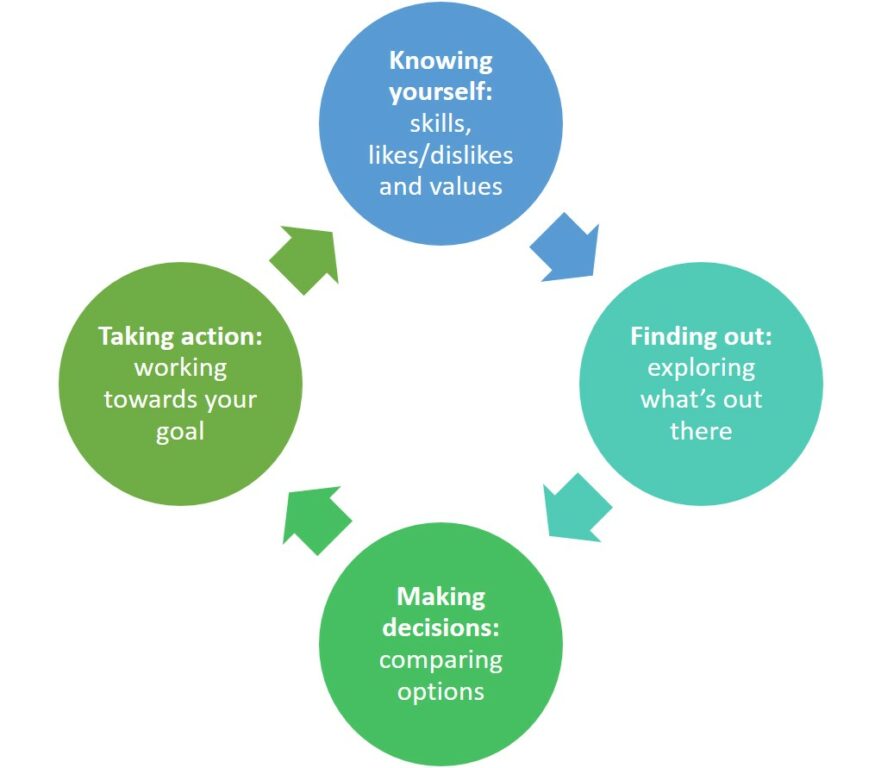
Think of career planning as a continuous process of:

  • Reflecting on your interests, values, skills and preferences
  • Exploring the life, work and learning options available to you
  • Ensuring that your work fits with your personal circumstances
  • Fine-tuning your work and learning plans to help you manage changes in life and work

You can revisit and use this process at any stage of your career.

Start at the step that is most relevant for you now.

Planning cycle

The career planning process has four fundamental steps:

Step 1: knowing yourself

Step 2: finding out

Step 3: making decisions

Step 4: taking action

Let’s take a look at each step.

Step 1: knowing yourself

Ask yourself:

  • Where am I at in knowledge and skills now?
  • What do I want out of a job or career?
  • What do I like to do?
  • What are my strengths?
  • What is important to me?
  • Where do I want to be?
  • How will I get there?

After this, you can work on getting to know your skills, interests and values.

At the end of this step, you will have a clearer idea of your work or learning goal and your individual preferences.

The SWOT analysis in Article 1 can also be of great use to you at this point. You can use this information about yourself like your personal ‘wish list’ against which you can compare all the information you gather in the next step: finding out. Your personal preferences are very useful for helping you choose your current best option, which you can do in Step 3: making decisions.

Step 2: finding out

This step is about exploring the roles and learning areas that interest you. Once you have some idea of your job preferences you can research the specific skills and qualifications required in those professions.

  • Explore. Ask people around you about their roles, how they achieved success in their career. This mentoring program is an excellent forum for learning about others’ stories how they built their career.
  • Identify. Pick out roles that interest you. Assess whether your skills and interests match up with the job’s requirements. Do you have skills that are transferrable for this particular role or profession?
  • Develop. Taking on projects in your current workplace is a great way to close any knowledge and skills gaps to further your career journey. Also, look at developing skills outside of work. Sporting, community and charity groups always need people with a vast range of skills.
  • Locate. Do research not just on careers but on companies who you think you’d like to work with and where your interests and values align. Find out where your preferred roles are on offer.

At the end of this step you will have a list of preferred roles, companies you’d like to work with and opportunities for further learning.

Step 3: making decisions

This step involves comparing your options, narrowing down your choices and thinking about what currently suits you best.

Ask yourself:

  • What are my best work or training options? How will these currently impact on my work and life situation? How long will it take to get appropriate knowledge or qualifications and how do I manage my career in the meantime?
  • How do they match with my skills, interests and values?
  • How do they fit with the current labour market? What’s happening in the economy and politically? Is there opportunity for career growth within my current organisation or region?
  • How do they fit with my current situation and responsibilities?
  • What are the advantages and disadvantages of each option?
  • What will help and what will hinder me?
  • What can I do about it?

At the end of this step you will have narrowed down your options and have more of an idea of what you need to do next to help you achieve your goals. We would recommend that you use the Kolb Action Learning model in your Mentoring Resource book. This will provide an excellent tool to assist you at this stage of planning.

Step 4: taking action

Here you plan the steps you need to take.

Use all you have learnt about your skills, interests and values together with the information you have gathered about the world of work to create your plan.

Begin by asking yourself:

  • What steps will help me achieve my work, training and career goals?
  • Where can I get help?
  • Who will support me? Who can give me a reality check about my choice at this stage? What might be some of the barriers moving forward and how will I overcome them?

At the end of this step you will have:

  • A plan to help you explore your options further (work experience, work shadowing or more research); or
  • A plan which sets out the steps to help you achieve your next learning or work goal
  • Decide which step is relevant for you right now and start from there.

In all of this you need to remember that your career doesn’t happen in isolation to other aspects of your life.

As you work your way through the model ensure that you’re taking your entire life circumstance into any decisions you make.

Empathetic and factual communication during uncertain times

By Peter Russo FIML

In front of you lays an ever-increasing amount of distressing news, and growing uncertainty. It’s hard to see what your workplace tomorrow, let alone later today, will look like. Your staff are also confronted by this, becoming increasingly apprehensive, which weighs heavily on them – a knot is building in your stomach. The obstacles perhaps seem insurmountable, and your attempts to find answers just create more questions. You are dealing with an unprecedented event in modern times, and it is now, more than ever, a time to become people-centric as a leader. When the mechanical aspects of business seem to be in seizure, you need to draw on the more visceral attribute of leadership – being human.

Throughout history there are multiple examples where collaboration underwrote the resilience for a group to overcome adversity. The remedy to our current state of affairs is no different. Therefore, it’s vital that you are engaging your staff about not only the economic realities facing your business, but the human aspect. The only way to do this is by showing empathy and dealing with facts.

Why empathy and truthfulness matter

In today’s world people are faced with an incredible number of opinions, some of which are generated with the intent to sensationalise. This creates anxiety, and only acts in the interest of derision as a community.

Your message must be clear, empathetic and constructive. No one has all the answers, but you – as a leader – can provide them with a feeling of security, and you shouldn’t be afraid to admit you don’t know. It’s support, not false-hopes, that will bind your team and ensure you’re moving together in the right direction.

The 24-hour news cycle, and the relentless bombardment of news only acts to aggravate fear and panic. What your staff really need is a clear, concise and candid outlining of facts.

What you can do as a leader

Here are some ideas on how to provide empathetic and factual communication during uncertain times:

  • Give regular updates. Do it often and in simple digestible portions. As a suggestion, at least every second day and more often for staff who have been isolated or working from home for an extended period.
  • Provide timely information. Tell your teams what you know now rather than waiting until you have all the answers. Use all appropriate channels to communicate new information regularly.
  • Do not exaggerate. Whether it is good or bad, stick to the facts. Do not simply look for a positive spin.
  • Use a collaboration of ideas. Often staff have sound ideas that can help. Be prepared to unpack those ideas and push them up the organisational chain. In adversity, very few ideas are considered bad ideas as everyone has a part to play.
  • Recognise and acknowledge emotions. Understand the behaviours we see are the proverbial tip of the iceberg; the result of the underlying emotions, including fear, doubt and concern. Have open conversations to help allay fears.
  • Be open and honest. It is very important to ensure you keep your staff in the loop on how decisions are made and what considerations are being taken.
  • Make yourself available. Finally, check-in with your staff. Sometimes a simple ‘how are you?’ can break down barriers resulting from isolation.

The challenges we are facing are unprecedented in modern times. The foundations of our society are being tested, and we ought not forget that. Social distancing is impacting the fabric of our communities and how we collaborate. For many, the work environment, whether it be virtual or physical, is now their sole community linkage and it is essential they maintain a sense of belonging in such an environment. Remember, adversity builds character and over the longer term can bring people together. Create the work community that helps bring staff together and that has some semblance of normal, in a not so normal world at present.

No matter how this turns out, your business will invariably reshape. You therefore are tasked with quite an exciting opportunity – to use a crisis to embed humanistic leadership practices.


Peter Russo is a sessional lecturer at RMIT University and the founder of Engaging Leaders, a  professional training and coaching consultancy.


The value of self-discovery for leaders

By Wayne Smithson CMgr FIML


After a 40-year career at senior finance positions and having studied in some form for most of that time, I didn’t think I needed to learn anything about my leadership style.

So, when I was asked to consider becoming a Chartered Manager, I thought that this would be a relatively easy and quick process – a first misconception. I also thought that in my position as program director, there would not be any real obvious benefits for either myself or the organisation – my second misconception.


A journey of self-reflection

When I commenced the process of becoming chartered, I thought that leadership, a complex and well-covered academic topic, really comes down to experiences and self-anecdotal evidence.

However, these anecdotes and experiences are only valuable if they are intentionally recalled and put into practice. There’s no point assuming that the skills can be stored and accessed on demand.

The process appeared simple. Although in my current role, some of the leadership questions in the submission did not seem relevant at first glance.


Reflecting on the reality of one’s unique role

As a program director for the Bachelor of Accounting program for Universal Business School Sydney, I didn’t realise that the current business model I work within called for a different approach to leadership. Call it a transitional contingency approach to leadership if you will.

As with many private higher education providers and universities, the business model involves the tensions created by contractual employment. It can be called a “sessional” workforce, with ongoing employment determined by the demand for the subjects being offered.

This factor alone presents several unusual leadership challenges, not the least is developing and implementing a coherent business unit plan.

By comparison, this would have been a more manageable task had I applied my experiences in a commercial context which mostly meant management of permanent staff. However, with some critical thought, the contingent nature of my leadership role became evident.


The value of self-reflection

So what were the benefits for me?

The combination of my written reflection document and the probing questions were the catalysts for leadership self-discovery. It revealed my leadership style and attributes that I apply in my daily management and leadership role.

The three main benefits of self-reflection include learning about:

  • The known – the affirmation of leadership skills of which I was consciously aware and practised well.
  • The unknown – identification of in leadership skills in which were weak and requiring more attention and focus.
  • The unknown unknowns – highlighting leadership traits of which I was not aware I was employing.


Of these, the last two were the real eye-openers concerning my role, with the potential to ultimately benefit my team’s effectiveness.

Overall this exercise alone heightened my leadership awareness and intensity, in particular, the “contingent” nature of the leadership skills I have applied in my role.

Identifying where I could improve the application of those skills, however, was eye-opening. Identifying the skills I was employing and was not consciously aware was the big win.

I have now taken these learnings forward in the workplace and generally reflect across the areas of focus required to be a leader.


What are the benefits for the organisation?

Although, from an organisational perspective, the benefits can be somewhat intangible, all management and leadership training results typically in a positive cascading effect throughout all levels of the organisation.

Arguably the potential organisational benefits relate specifically to:

  • Highly effective team management
  • Improved team focus and direction
  • Greater productivity


I recommend the Chartered Manager program to all those in the academic field, not just for the internationally recognised accreditation, but also for the self-discovery in leadership that it provides. It’s an excellent opportunity for leadership awareness and practical course correction.


Wayne Smithson is Program Director of the Bachelor of Business Program at Universal Business School Sydney (UBSS). He is a Fellow of IML ANZ and a Chartered Manager.

Five tips for successfully managing people

As told to Andy McLean MIML

In a leadership career spanning five decades, Chris Golis FIML has learned a thing or few about managing people. In this article, he shares five tips for a successful life and career.

1. ONE-ON-ONE MEETINGS MATTER

In 1973 I was flown twice to New York by McKinsey & Company and offered a job – but I must be one of only a few people to ever turn them down. My MBA tutor was Charles Handy [who later became a world-famous management guru] and he said to me, “Chris, I’m not sure I’d take that if I were you. I’ve been thinking about what makes business success and have come to the conclusion that it’s being able to handle yourself in a one-on-one meeting. That’s when you get the job, hire someone, get fired, secure the funding, come up with a business plan, and so on.” I took his advice and instead pursued a sales career. I arrived in Sydney the same week that the Sydney Opera House opened.

2. PEOPLE DRIVE PERFORMANCE, EMOTIONS DRIVE PEOPLE, TEMPERAMENT DRIVES EMOTIONS

In sales I learned that we sell to people’s heart, not to people’s head. Understanding someone’s temperament is absolutely vital if you want to get the best out of them. The problem is most managers do not have a scientifically valid model of temperament to help them determine their own and other people’s core emotions. I practise and teach the most practical temperament tool available, the 7MTF which can dramatically lift your emotional intelligence. In the same way the Humm-Wadsworth temperament model is built on the earlier work of Rosanoff, the 7MTF builds on the work done by Humm and Wadsworth. All three models conceive our temperament traits as based on one’s position on the various spectra of mental illnesses.

3. ABOVE ALL, PEOPLE SKILLS MATTER

In 2005, my elder daughter Louisa was asked to run a team of 30 people at Perpetual before she was 30. She asked me a good question: “Dad, you have read all the business books, what do you recommend I read?” I began by referring her to research among Australian managers that showed ‘people skills’ ranked as far and away the most important leadership capability. So I said to Louisa she should read a book that would improve her people skills. After some thought, I realised that there was no practical handbook written to help new managers develop their people skills so I decided that I had to write one myself. Thus The Humm Handbook: Lifting Your Level of Emotional Intelligence was born and published in 2007. (Read details of the book at emotionalintelligencecourse.com.)

4. LEADERS CAN LEARN A LOT FROM THE CLASSICS

At the end of my book, I analysed five classic plays as business case studies. Why? Because theatre gives us a picture of what we are and what we want to be. It helps us to find out about ourselves and others. So I analysed three Shakespeare plays, as well as Death of a Salesman and Antigone, through the prism of emotional intelligence. In each play, the hero suffers a terrible reversal of fortune and loses everything they hold most dear. We can see how their personality traits inform the decisions they make, and can draw business lessons from these to enhance our own emotional intelligence. (For more, read this article listing five leadership lessons from Shakespeare)

5. PRIORITISE WHAT IS MOST IMPORTANT TO YOU

I survived cancer in 2000, 2014 and 2019 (my daughters say I’m now a cat with six lives!). Facing your own mortality changes your outlook on life. When I realised there was a chance I was going to die, I decided to empower the people around me to let them make decisions. I loved my work in venture capitalism but also knew business life would one day have to continue without me. I also asked myself: “What do I want out of life?” In 2000, my wife and I drew up a bucket list of places we wanted to visit and, since then, we’ve been on two overseas trips every year.


Chris Golis FIML is the CEO and lead presenter at Emotional Intelligence Courses.

Andy McLean MIML is the Editorial Director of Leadership Matters magazine.


This article originally appeared in the December 2019 print edition of Leadership Matters, IML ANZ’s exclusive Member’s magazine. For editorial suggestions and enquiries, please contact karyl.estrella@managersandleaders.com.au.

Earning trust: Five building blocks for cultivating trust

By Nicola Field

As human beings our default position is to trust others. Research noted in the Harvard Business Review (HBR) shows that human beings are naturally predisposed to trust – it’s in our genes and our childhood learning.. And most of the time it is a survival mechanism that has served our species well.

It’s only when we find evidence to the contrary that we stop trusting. And judging by the 2019 Edelman Trust Barometer, this is exactly what’s happening.

“The past decade has seen a loss of faith in traditional authority figures and institutions,” said Richard Edelman, president and CEO of Edelman.

He explains that there is a growing feeling of pessimism about the future, with only one in three mass population respondents in the developed world believing his or her family will be better off in the next five years. Just one in five believe ‘the system’ is working for them, and 70% desire change.

Tony Beaven CMgr FIML, General Manager of Elders Financial Planning, believes the erosion of trust within institutions has a lot to do with the environment we live in today. The pace of globalisation, disruption, and technological advancement are all making trust an increasingly scarce commodity for the majority of business leaders. As Beaven explains, “This can often see the needs of the organisation take priority over the relational aspects of building and maintaining the trust relationship throughout the organisation.”

And the erosion of our natural predisposition to trust goes even deeper than that.

Darren Fleming, behavioural scientist and author of Don’t Be A D!ck, says, “We tend to regard people who don’t trust as paranoid. But in many ways our sense of trust has been abused, and a lack of trust is the outcome. “If we look around the world, leaders haven’t been doing what we want them to do. This has led to a disconnect from leaders who are supposed to be pursuing our interests. The banking royal commission highlighted that we can’t always trust leaders in our business community – again because they weren’t doing what we believe they should be doing.”

Gabrielle Dolan, speaker and author on business storytelling and real communication, offers this perspective: “In these days of ‘fake news’ and ‘alternative facts’ we are moving away from that default position of trust, and becoming inherently more suspicious. The result is that leaders have to work harder to gain trust.”

A NEW TREND IS EMERGING

While the 2019 Edelman Trust Barometer signifies that people are generally less trustful, we haven’t entirely given up on trust.

Edelman says, “People have lost confidence in the social platforms that fostered peer-to-peer trust. These forces have led people to shift their trust to the relationships within their control, most notably their employers.”

Intriguingly, Edelman found 75% of people globally trust their employer to do what is right. Moreover, 76% are looking to business leaders to create positive change.

This suggests leaders and managers have some solid responsibilities to live up to. But why does trust even matter? And how can it be nurtured?

TRUST IS VITAL ON MANY FRONTS

Beaven says trust is important “because if you don’t allocate enough time to get the right balance of relational factors versus the business needs of the organisation, your business is potentially subject to turnover issues and a diminishing culture that can ultimately impact the survival of the organisation.”

For Fleming, the issue is clear cut. “Without trust nothing happens. We only get in our cars because we trust that people will drive on the correct side of the road. We turn up to our jobs because we trust that we’ll get paid.”

Fleming adds, “Trust is what allows us to contribute. If we don’t have trust, we have to second guess everything going on.”

As Beaven points out, trust can deliver real advantages to organisations. Dolan expands on that point, saying, “When employees have trust, decisions can be made more quickly, and workplace teams are more likely to buy into those decisions.”

She adds, “Trust also makes change easier because employees are confident that leaders will look after them and do the ‘right thing’ by them. Trust is especially critical in peak periods as staff can be sure that leaders ‘have their back’, and consequently they are likely to give more.”

FIVE BUILDING BLOCKS OF TRUST

The big question is how managers and leaders can go about building trust. It’s not always an easy task, especially as Australians and Kiwis have what Dolan diplomatically refers to as “a tremendous capacity to detect the inauthentic.”

As Fleming notes, “Developing trust calls for a far more proactive approach than a simple open door policy – after all, the trap door spider also has an open door policy.” Here are five proactive steps that leaders can take.

1. TRANSPARENCY

A key starting point in developing trust is transparency. “If you say you are going to do something, then do it,” advises Fleming. “Explain why you are acting in a particular way.”

He adds, “This is where politicians often get things so wrong. People are big enough to handle the truth but politicians don’t give it to us. Instead they try to secure the popular vote by not being truthful.”

Dolan agrees that transparency is essential. She adds, “It is very important to have transparent communication. Even if you have nothing to communicate, let your team know this.”

2. STRONG PERSONAL CONVICTIONS

“Good leaders with strong personal convictions explain what they are doing,” says Fleming.

“A lot of the time people in the workforce don’t know why they’re doing something. If someone on your team questions why they have been asked to complete a task, explain why. It’s not good enough to just say ‘because I’m in charge’.”

3. DON’T AIM TO BE PERFECT

Be prepared to show a vulnerable side. Dolan explains, “The leadership style of never showing weakness, never making mistakes and having all the answers is outdated. The ability to show a vulnerable side calls for courage and self-assurance.”

According to Dolan, being able to show vulnerability is a sign of strength. Conversely, refusing to demonstrate vulnerability is a sign of weakness.

“The maxim that ‘perfect leaders aren’t real, and real leaders are imperfect’ is very true,” says Dolan. “When someone is trying to be too perfect they don’t come across as approachable, and we aren’t comfortable with them.”

This view is confirmed by the HBR study, which found we’re far more likely to trust people who are similar to us in some dimension.

4. INVITE, LISTEN, OBSERVE

Fleming has developed his own mantra for building trust, “Don’t turn your back on people, don’t cover your ears, and don’t close your heart”.

He explains this saying, “Invite people into conversations. We are social creatures and we don’t like to be excluded. When you include people, they feel protected because they are part of the tribe.”

Be prepared to listen to others. “We all have a voice and we all want to share and contribute,” adds Fleming. “When you shut people down they become resentful.”

Keeping your heart open matters too. As Fleming notes, “It can be difficult to find a balance between leading and building trust. It’s about knowing your people, reading the environment and having social awareness.

“Observe your team, ask if everything is okay, and adopt an empathetic person-to-person approach. We’re all people trying to get through life. A lot of leaders lose sight of this amid the ‘we’re here to make money’ attitude.”

5. SHARE PERSONAL STORIES

Dolan recommends sharing personal stories to build trust. “It can be very powerful as long as you’re sending a business message to demonstrate personal values,” she explains. However, this calls for leaders to truly know their own values, such as integrity, respect and teamwork.

“Do things that demonstrate your values,” says Dolan. “For example, you may believe in the value of feedback but this means you need to be able to accept feedback yourself.”

Storytelling can be used at team meetings, presentations, or even in a one-on-one situation. Dolan offers an example of how very public storytelling can deepen relationships.

“A client of mine was speaking at an event, and she openly described how the amount of time she was spending at work was starting to threaten her marriage,” notes Dolan. “It was a deeply personal anecdote. But by sharing it she was acknowledging ‘I haven’t got this right’.

“The response from the audience was exceptional,” adds Dolan. “Many people thanked the speaker – it just hadn’t occurred to those she worked with that this person would be having these sorts of issues. It gave others permission to share their story.”


This article originally appeared in the December 2019 print edition of Leadership Matters, IML ANZ’s exclusive Member’s magazine. For editorial suggestions and enquiries, please contact karyl.estrella@managersandleaders.com.au.

Four ways psychology influences strong leadership

Young leader and registered psychologist, Rheza Tan CMgr MIML, lists how the mind impacts effective management.

1. MASTER THE LEADERSHIP MINDSET

When I studied business, I found that many leadership concepts are drawn from psychology or informed by the science. The two main lessons that I keep in mind are:

  • Look after people. Don’t just focus on the bottom line. If you look after your people, then they’ll do the same for you and your organisation.
  • Have meaning and purpose. As these are higher-level needs, once people meet their basic needs, they search for meaning and purpose. I found that leaders who share their sense of purpose with their staff and organisation support others in fulfilling their higher-level needs too.

2. CULTIVATE A POSITIVE VIEW

Although I was primarily trained to help people with diagnosed mental illness, when I became a manager I was drawn to positive psychology. It’s about assisting healthy people to increase their wellbeing and happiness. The focus is on enhancing the positive rather than eliminating the negative. When I dug deeper, I found that positive psychology, and business and executive coaching are becoming really intertwined. There’s a strong alignment between positive psychology and coaching. Leaders can use positive psychology models and apply those when helping their teams.

3. LISTEN TO THE UNHEARD

Both personally and professionally I’m drawn to assist those from a culturally and linguistically diverse background – including students, migrants and refugees. Regardless of where people come from, there’s always a struggle to adjust to a new culture. The greater issue they face is a lack of good mental health literacy. Many cultures don’t acknowledge mental health issues. In some, they don’t even have words to describe concepts like anxiety and depression. So it can be challenging for them to get support. As a migrant myself, I understand their experience. When they can speak to someone who understands, it really makes a huge difference.

4. DEVELOP AS A PROFESSIONAL AND AS A LEADER

Completing the Chartered Manager program was the first time I was exposed to a competency framework for leaders. Comparing myself against it was an excellent reflective process. I feel that it gave me an ongoing commitment to be competent as a professional leader. As Chartered Managers, we have a responsibility to uphold ethical business standards and a commitment to leadership development. I know many colleagues who are both health professionals and leaders. While they tend to continue clinical training, they don’t always develop their management knowledge or leadership skills in the same way. Now, I complete professional development for two disciplines – as a psychologist and as a leader.


This article originally appeared in the September 2019 print edition of Leadership Matters, IML ANZ’s quarterly magazine. For editorial suggestions and enquiries, please contact karyl.estrella@managersandleaders.com.au.

Tips on becoming a stand-out leader

Sir John Storey Award winner, Gemma Wood MIML, is thriving as an emerging leader in the male-dominated sector of engineering and infrastructure. Leadership Matters asked her for her tips on becoming a stand-out young leader.


1. BROADEN YOUR MIND

Gemma_Wood
Gemma Wood MIML

I volunteered in Kenya and deliberately picked somewhere that’s basically as far away from home as I could get. It was a really good experience because I not only discovered more about the Kenyans’ culture but also learned so much more about my own culture. It opened my mind a lot.


2. RESPECT DIFFERENCES

It’s important to understand that factors like people’s upbringing and culture, background, language and spirituality contributes to how they think and operate. As leaders, it’s our responsibility to have some insight into that and consider what might make people comfortable and how best to work with them. For example, I must be aware of the wording I use and how I speak to someone. Acknowledging that some things are ‘different’, not weird. How we speak can have such an impact on a person.


3. LEAD WITH HEART

An unforgettable leadership moment for me was when my boss was faced with a situation that was not in the best interest of his people. My boss, as the leader, decided to put his people’s wellbeing first, no matter how much money it cost the business. And to me it is so incredibly important for leaders to back their team, having their best interests at heart. When people feel really appreciated and feel that they’re adding value, you’re going to get that discretionary effort out of them. They’re going to be really positive and invested in what they do.


4. RECOGNISE TRUE RESILIENCE

There’s a lot of talk about resilience. It’s such a buzzword. But I think, no matter how resilient a person is, it’s important to notice when high stress becomes the norm. That’s when you need to recognise enough is enough, and say ‘no’. Resilience is a great thing to work on and build up, but high stress should never ever become the norm because then you can’t bounce back. So, it’s an awareness of when to be resilient or when things have gone too far, and you have to say ‘no’ for your health or the health of your team.


This article originally appeared in the June 2019 print edition of Leadership Matters, IML ANZ’s quarterly magazine. For editorial suggestions and enquiries, please contact karyl.estrella@managersandleaders.com.au.
The business of mindfulness in modern workplaces

By Anthony O’Brien


It’s not the start of an Irish joke, but what do search engine Google, retailer Target and bank JP Morgan, share in common? Apart from making plenty of moolah, these corporate heavyweights have introduced a commitment to mindfulness practices into their workplaces in recent years.

While often associated with adherents to the Buddha rather than mammon, mindfulness training courses are becoming common in New Zealand and Australian workplaces as firms seek ways to reduce stress and absenteeism, increase productivity, develop better leaders, and generate more creative workplaces.

The Australian Psychological Society’s website says work-related stress results when the demands of work exceed resources for managing those demands. Another report from the Victorian Government says workers experience stress over organisation culture, bad management practices, job demands, the physical work environment, relationships at work, change management, lack of support, role conflict and trauma.


MINDFUL LEADERSHIP

As a leadership tactic, mindfulness helps people to be more effective by directing focus to the most pertinent task at hand, according to Harvard Business Review. Deprogramming multi-tasking tendencies and intentionally focusing with full attention results in higher quality interactions and decisions, says HBR.

Pippa Hanson CMgr FIML, Chief Executive Officer from The Sports Injury Clinic, regularly speaks on the topics of stress management, work-life balance and thriving under pressure. The IML ANZ Member believes the age of the mobile phone and the internet has increased the need for mindfulness. “People are on their emails, not just when they’re sitting in front of a computer but they’re getting access on their phones. They’re carrying those phones around with them, they’re contactable 24/7 if they’re not putting boundaries in place.”

Creating boundaries is being mindful of what limits you’re setting for yourself as a manager and leader, “not only to complete your day-to-day activities, but so you know what your day looks like and what time it starts and finishes,” Hanson advises. “If you allow your day to be interrupted by responding to every email, you’re not mindful of what your day looks like, and that causes pressure, stress, poor mental health, and a lack of productivity. So, a lack of mindfulness has a negative impact on people’s work day.” Hanson also advises managers and leaders to be aware of how many times per day they check emails, while strategies such as turning off app notifications, can improve mindfulness.


DEFINING MINDFULNESS

Hanson says mindfulness can be confusing for the uninitiated. “I find some people only associate it with meditation or colouring in. They don’t believe that they’re mindful when they do other activities like crafts,” she says. “Mindfulness is about being present and aware of your current situation, rather than being on a mouse wheel and just going through the motions every day.”

For Hanson, who manages a busy allied health business employing 60 staff including health practitioners and administrators, mindfulness includes taking a midday break to assess the first half of the day before the afternoon shift begins. “I walk, at the end of the day because after a busy schedule of meetings, phone calls and face-to-face contact, just walking and listening to a podcast, radio or music, allows me to switch off from work, before I step back into family time.”

Hanson adds that mindfulness doesn’t just speak to physical fitness, but mental fitness and the ability to cope with pressure, stress, and the unexpected.


Mindful leader, Catherine Stock-Haanstra FIML


FINDING THE SWEET SPOT

A 90-day mindfulness plan has been around since Warren Buffett was a boy. But it’s only now becoming more widely accepted in business, says Hanson. “Mindfulness has crossed over into leadership in the workplace for health and wellness as well as business strategy and time management.” While practising mindfulness is part of Hanson’s daily routine, it is also a major component of her firm’s broader strategy. “Our leadership team takes a day every quarter to switch off from everything. This day is about focusing on our achievements and where we’re going, but really without interruption and without taking the phone calls and without reacting to the emails. This enables us to be present, slow down and focus without the extra pressure.”

Hanson says individuals will have a unique mindfulness sweet spot. “Mindfulness is different for everyone, and everyone does respond differently, and it’s about identifying that for yourself. There are simple breathing strategies that you can do at lunchtime to slow your heart rate down, and to take those deep breaths, which when you’re rushing and busy you don’t often do. Others might walk around the block, or someone might say, ‘No, I’m going to put my headphones on and listen to music for 10 minutes’.”

Laps of a pool give swimmers plenty of time to cogitate and practise mindfulness, while Hanson says some people gain satisfaction from running or riding. “When you’re focusing solely on something different, your present activity, you are switching off from work, or your family life because you can’t think of both of those things at the same time.”

If managers and leaders can understand mindfulness, they are better placed to educate their teams. “Maybe the phones haven’t stopped and the team won’t take a lunch break or a tea break. However, if managers and leaders can teach their employees about walking away and getting some fresh air and then coming back, it just makes for better relations in workplaces, better relations with clients and better outcomes for everyone.”


The full version of this article originally appeared in the September 2019 print edition of Leadership Matters, IML ANZ’s quarterly magazine. For editorial suggestions and enquiries, please contact karyl.estrella@managersandleaders.com.au.