A Chartered Manager strengthens his commitment to the leadership profession

We recently sat down with Gareth Sipple-Asher CMgr MIML to chat about what it means to become a Chartered Manager. Sipple-Asher received the designation through IML ANZ’s Pathway Partnership with Griffith University. In this interview, he reflects on his journey, shares lessons learned and provides advice for others on the pathway to becoming Chartered.

What did you learn throughout the process of becoming a Chartered Manager?

The key learning for me is the significance of our commitment to the profession of leadership. Our conduct and the way we treat people, be they colleagues or those under our care, demonstrates our level of commitment to the wider community. If our ethical values hold no substance and we choose to flaunt them as a way of building superficial trust or recognition, then our core values are built on a lie that will eventually be discovered. If we build our values around an agreed code of conduct, as leaders, we instil a sense of personal responsibility and accountability across our community and with it a strong sense of cultural awareness.  

Gareth Sipple-Asher CMgr MIML

How has the process of becoming Chartered benefited you?

The process helped me to understand the value of committing to the CPD. We often have good intentions when considering our personal development. Unfortunately, the responsibilities we have outside of our personal growth give us an excuse to keep putting it off. I have realised a vast resource that offers an abundance of knowledge at my fingertips. All that is required is a personal commitment to continued learning as a perpetual student of leadership.

How valuable was it for Griffith to offer Chartered Manager as part of their MBA program?

I strongly believe the offer to become a Chartered Manager through Griffith provides the vital link that seeks to align hard and soft leadership skills. Becoming Chartered for me is not a badge or a membership, it’s a commitment to uphold a code of conduct that underpins sustainable leadership. Griffith University actively promotes the commercial value behind environmental sustainability. By offering MBA students the chance to become Chartered, Griffith University is also promoting the commercial advantage of sustainable leadership.

What tips would you give to others who are completing their Chartered Manager Assessment?

The opportunity to become Chartered does not only apply to individuals in leadership roles. Positive cultural change can take many forms. Effective leadership relies on the conversion of early adopters to take up a cause and build its value from within. Chartered Managers who form part of the stakeholder community and live the values through their commitment to the charter are as valuable to the organisation as the leaders above them.

Having the confidence and resolve to call out toxic leadership or unethical behaviour is the ultimate way to manage up and ensure those in charge are held accountable to the values of the organisation. Becoming Chartered will not only help you as a leader, but it will also offer a distinct advantage to your capability as a professional.


Get on the pathway to better leadership

If you’d like to find out more about how IML ANZ can support you to include the internationally recognised Chartered Manager designation as part of your curriculum, please contact our Higher Education partnership team at partnership@managersandleaders.com.au

Two ethical virtues in times of crisis

By Dr Simon Burgess

As a leader, what are the most essential qualities to possess in times of crisis? Credibility, determination, a reassuring presence, and adaptability all come to mind. After all, your team members want you to be straight with them. They want to retain a sense of purpose, and they want to be able to have confidence in you. If they don’t get clear and credible information from you, they’ll be sure to disengage and get what they want elsewhere.

Now the truth is that all of that applies at any time. Like many fundamental insights about leadership, it can be worth bearing in mind regardless of whether things are chaotic or calm. But in any case, let’s consider a couple of ethical virtues that are perhaps especially relevant in times of crisis. One of these is empathy. The other is principled integrity. Both are vital in maintaining trust during trying times.

Lead with empathy

In some ways, leading through the current coronavirus pandemic is akin to the situation faced by business and civic leaders in New York following the terrorist attacks on September 11, 2001. While the carnage was both horrifying and bewildering, clearly those leaders weren’t responsible for any of it. Their responsibilities were entirely concerned with how best to respond. And virtually without exception, the people they led were immediately ready and willing to accept all the guidance that their leaders were able to provide. Rudy Guiliani, in particular, the mayor of New York at the time, is rightly admired for the empathic role that he performed.

Admittedly, Guiliani has never been universally admired. Moreover, his reputation has taken several serious turns for the worse since he joined the Trump administration. But without pretending that Guiliani has ever been perfect (and no leader is), let’s try to remember the kind of empathic leadership style that he showed back in 2001.

Importantly, his empathy wasn’t mere sentimentality. He didn’t cry in public or put his emotions on display. In fact, in his book Leadership, he explains that “there was no time to spend actually experiencing an emotion. There were moments of anger, fear, and sorrow, but with so much to do it was impossible to dwell on those feelings.”

But Guiliani clearly was emotionally ‘tuned in’ with those around him. He listened to the experts, and his emotional intelligence was central to the open, adaptable, and sure-footed leadership that he provided. His empathy also went hand-in-hand with his confidence that all kinds of people would rise to the occasion, and when we recognise a leader’s empathy in that form, it naturally brings out the best in us. Notwithstanding the shock and grief that were so widely shared, that empathic style actually raises morale and generates a sense of resilience, fortitude, and purpose.

Make decisions based on principled integrity

Without a doubt, something that many organisational leaders will have been quietly contemplating in recent months is the idea that one ‘should never let a good crisis go to waste.’ It’s an idea that has been most avidly promoted in recent years by Rahm Emanuel, former Chicago mayor and President Obama’s first chief of staff. And admittedly, it’s an idea that can be very tempting. When a crisis that isn’t of your own making comes along, it is often possible to exploit it. Put simply, you can use it as a pretext for something that you’ve long wanted to do (whether it be related to structure, strategy, policy or personnel) but for which you have never been able to gain support.

Crises need to be addressed squarely, decisively, and sometimes with radical action. But even in a state of crisis, our actions should be principled. They should always be based on a genuine rationale; one that can be defended with honesty and candour. If your organisation needs a restructure, argue for a restructure. If you want to reassign certain personnel, give honest reasons for your view. But if your supposed need for such changes isn’t genuinely due to the current crisis, don’t pretend that it is. Understanding the context is one thing. Exploiting it as a pretext is quite another.


Simon Burgess is a lecturer in Ethical Leadership at the University of New England Armidale.

Personal, organisational and national resilience: lessons from three African nations

By Sam Durland FIML

A few years ago, I had a brief encounter with Julia Gillard, during which I asked her how she had managed to cope with the rough and tumble of politics during a particularly tumultuous time in Australia’s recent history. She answered with one word: resilience. Indeed, in her autobiography, Gillard devotes an entire chapter to resilience, which she ascribes to a sense of purpose.

For me, resilience means the ability to overcome major challenges or setbacks. Over the past 20 years, working as an international development consultant and adviser in several African countries, I have encountered numerous examples of resilience at an individual, organisational and national level.

Personal resilience: a lesson from Uganda

In Uganda, I worked with a local entrepreneur who was developing several enterprises based on primary production. The aim is to enable his poor district in the west of the country to become self-sufficient instead of importing foods and raw materials from elsewhere. He was not driven by a need to generate wealth for himself; instead, a burning desire to provide employment and a secure future for his people. He faced many obstacles, from government officials trying to exact bribes for the services they were charged with providing, to a system of land ownership that made it difficult to obtain secure title to agricultural land.

My client was dogged in his resistance to illegal payments and unrelenting in his efforts to register his land title. I especially marvelled at how he dealt with public servants, who put my client at risk of not receiving the requested service, or more alarming, put his safety in danger. In the end, sheer persistence won the day, and the service was rendered without the payment of a bribe.

The lesson: In reflecting on my client’s character, which I believe formed the foundation of his success, I would describe him as exhibiting resilience based on a strong sense of purpose and an overwhelming desire to be of service to his people.

Organisational resilience: a lesson from Lesotho

In the small African country of Lesotho, I worked with a dedicated group of local and international consultants and advisers on a United States-funded project to develop a new government agency that would provide secure land ownership for the country’s citizens. This agency was intended to replace a government department that was widely thought to be both corrupt and inefficient in its dealings with the general public. Members of the project staff faced a major obstacle in the form of pushback from political interests who appeared reluctant towards change.

Project staff found that they were prevented from meeting with key public servants, they had their furniture removed from their offices, and there was even an attempt to confiscate their computer equipment.

The lesson: Despite these and other setbacks, they were resolute in their determination that the project should succeed (and it did), knowing that there was widespread community support for the initiative, as well as obvious benefits for the country’s economy. In the face of strong opposition, this group displayed resilience based on a sense of integrity and a commitment to do what is right.

National resilience: A lesson from Liberia

Finally, I turn to the West African country of Liberia, recently wracked by an Ebola-virus epidemic and still recovering from a 14-year-long civil war. As a consequence of the war, much of the country’s infrastructure had been decimated and government departments’ records destroyed or rendered incomplete. Here, my role was to work with a team of international and local consultants and advisers, and their counterparts in the public service, to develop a new authority designed to oversee land administration and land management in the country and overcome a fragmented and dysfunctional bureaucracy.

Both the war and the epidemic had significantly touched virtually every Liberian whom I came into contact with that time. Yet, despite the distinct challenges, they exhibited both an enthusiasm for our project and a positive outlook on the country’s future.

The lesson: I ascribe their resilience to a sense of positive leadership at the national level (their President, Ellen Johnson Sirleaf, had won the Nobel Peace Prize), a strong sense of national purpose, and a national character grounded in hope.

For me, an underpinning sense of hope is present in all of these examples of resilience. Hope’s power is epitomised by Desmond Tutu when he said, “Hope is being able to see that there is light despite all of the darkness”.


Sam Durland is a Fellow of IML ANZ. Sam’s consulting work has taken him to more than 20 countries in Asia, the Pacific, Africa and South America. He previously held senior executive positions with private enterprise, statutory authorities and government departments in Australia and overseas.


Strengthen your resilience

Leaders need resilience to cope with the daily stresses of work and life. But when the work environment has changed and you face new challenges, what can help you perform at your best?

Paralympian and corporate high-performance coach, Katrina Webb OAM MIML  will help take you through a three-phase process to manage your priorities, energy and your mind in our upcoming Virtual Event,  ‘The Road to Resilience’.

Mentoring: Support and advice during these tough times

When we are all surrounded by so much uncertainty, it helps to find someone we can trust.

From a professional perspective, a mentor can be just that – someone who has our best interest at heart. Although a manager might seem the best placed to provide work-related advice, sometimes it helps to get a different view of things.

Mentoring provides a safe sounding board

As the University of Melbourne’s Mobile Learning Business Manager, Edwina Coller AFIML explains, “There are often areas that mentees don’t want to discuss with their manager because it’s about them personally and not relevant to their role.”

During these tough times, we are all inundated with things that have changed, that we aren’t sure of and things that cause us to be fearful. We may not be comfortable discussing those things with our manager.

Fresh perspectives during tough times

Surviving through difficult circumstances can take a toll on our ability to think and make decisions. That’s why Onno Van Es FIML, Manager HR Strategy and Engagement at Mackay Hospital and Health Service, makes sure his mentees are clear about how the mentoring process can benefit them.

“My style of mentoring is based around adult learning principles. It’s not a lecture style of learning, where I provide all the answers. Rather, I focus on the mentee taking ownership of their learning by being internally motivated and self-directed,” says Van Es.

Whether you are looking for new perspectives, want a sounding board you can trust or simply need to expand your social and professional connections, mentoring can help you.


Become a mentor or mentee now

IML ANZ Members enjoy complimentary access to the Member Exchange mentoring program.

Now is your chance to give and gain support from other managers and leaders during this extraordinary period. A new mentoring cohort starts in mid-May. To take part, register here before 24 April.

MEMBER EXCHANGE – Tools and resources to get ahead

In an opinion piece for the Sydney Morning Herald, Jim Bright, professor of career education and development at ACU, discussed how to get ahead in your career and leadership. Bright states, “If you want to get ahead, work with what is in front of you, not what you think should be in front of you. Great leaders are great improvisers in the sense that they make do… with whatever is at their disposal”.

Indeed, it can be so easy to blame others or external circumstances for your situation – but leaders are decisive and get on with it regardless of the situation. They take limitations and turn them into opportunities to innovate and collaborate.

That’s why having the right tools or resources at hand matters. Depending on the situation you face, there is a wealth of materials leaders can draw upon to help them tackle the challenges.

Constructive criticism

Bright also discussed the need to surround yourself with “people who care enough to be critical in a positive way”. If leaders only surround themselves with “yes” people, a toxic environment can result as colleagues and staff resent the narrow view and are frustrated with their own inability to make changes. The “yes” people can be reasonably safe, but only for so long. Good leaders need people they can trust, who keep them honest, question, critique and explore opportunities.

Soft skills

Effective leaders need to have a vision, but the vision is limited if it can’t be communicated effectively. Effective leaders are hard on themselves in a way that creates growth rather than destruction. Effective leaders are flexible and adaptable enough to seek solutions to challenges and strong enough to hold their vision and include others in their successes.

Analytics tools

As a leader, it’s very important to have a grounded assessment of your strengths and areas of challenge. There are many psychometric tools available and if used as a tool, rather than a prescription, are very effective to know what strengths you play to and where your areas of growth could be. The list below is just a sample of what’s available – all have similarities and it’s really a matter of personal preference, access and cost.

  • Myers Briggs Type Indicator (MBTI) – personality tool
  • DiSC – behavioural profiling tool
  • Print – Unconscious Motivators tool
  • Strengths Finder (Tom Rath)
  • Life Styles Indicator (LSI) – underlying thoughts and motivations leading to behaviours
  • Enneagram – personality tool
  • Harrison Assessments – talent management tool

Books on leadership

There is a huge spectrum of leadership books on the market. The following list is a small introduction to get you thinking about different leadership elements and approaches.

  • The 7 Habits of Highly Effective People, by Stephen R. Covey, continues to be a very powerful self-development tool for leaders, especially if you are new to leadership.
  • The Truth about Trust (in Business), by Vanessa Hall, provides practical and anecdotal insights on how to increase results, retention and improve business relationships.
  • The Five Literacies of Global Leadership by Richard David Hames focussing on authentic leadership in a changing, and frequently challenging time.
  • Primal Leadership: Realising the Power of Emotional Intelligence by Daniel Goleman who builds on his Emotional Intelligence book and specifically looks at its application to leadership.
  • The 5 Levels of Leadership: Proven Steps to Maximise Your Potential by John C. Maxwell explains how leadership doesn’t come from a title, but it’s about the ability to inspire and build a team that produces not only results but also future leaders.
  • Start with Why: How Great Leaders Inspire Everyone to Take Action by Simon Sinek. Explores beyond what and how we do our roles and delves into the Why – because this is the thing that inspires us and those around us.
  • Leading from the Emerging Future: From Ego-System to Eco-System Economies by Otto Scharmer and Katrin Kaufer who explore the need for shifting from an “ego-system” focussed on oneself to an eco-system which emphasises the well-being of the whole.
  • Dialogue: The Art of Thinking Together by William Isaacs. This book, based on over ten years’ research, discusses the value within organisations to use language and listening successfully to build positive cultures.
  • The Leader’s Digest: Timeless Principles for Team and Organization Success by Jim Clemmer is a series of insights and bite-sized briefings on the timeless principles of leading people.
  • Clear Leadership: Sustaining Real Collaboration and Partnership at Work by Gervase R. Bushe who provides interesting and challenging insights into how to build organisational cultures without fear, creating a culture where healthy partnerships and collaboration are organised and sustained.
  • Leadership Matters: 7 Skills of Very Successful Leaders by David Pich and Ann Messenger. IML ANZ’s Chief Executive, David Pich and Board Chair, Ann Messenger provide insights on leadership shaped by practice rather than theory – the ‘perspiration’ rather than the ‘inspiration’.

MEMBER EXCHANGE – Tips for perfecting prioritisation

In the hustle of the modern workplace, it’s very easy to spend a lot of time completing not much. That is, people put a lot of time and effort into completing the least important jobs, while the things that really matter are overlooked or not given the attention they deserve.

Sometimes this is because we prefer to work on things that interest us, or we do the easy quick tasks because it is so satisfying to look at a list of completed jobs. Frequently, however, it is because we have not properly identified and prioritised what we should be doing.

So, what are the demands on your time? What techniques do you currently use to manage your time effectively? What tools can you use to help schedule tasks? How can technology help you prioritise?

Below are some guidelines to get you thinking about how to effectively prioritise your tasks and manage your time:

The five Ds

Most peoples’ days are so busy that they find it impossible to do everything. It is essential to decide what you will deal with now, do later, delegate, do only if time permits, and what you won’t do at all. This can help you develop a work schedule and set priorities that concentrate on activities that will contribute directly to your overall job goals. It allows you to distinguish between what’s important and unimportant, what’s vital and superfluous.

In summary, the five Ds:

  • Do it now
  • Do it later
  • Do it if time permits
  • Delegate it
  • Dump it

To-do list

A lot of people use a to-do list but how effective and methodical is yours? No matter how good your memory is you’re probably far too busy to remember everything you need to do. Lists are indispensable to keep you focused on what you need to accomplish to achieve your goals, no matter how hectic things get. They save you from the ‘tyranny of the urgent’ – attending to whatever floats across your field of vision, whatever seems the most urgent at the time, or whatever ‘makes the most noise’.

Here are some specific things that to-do lists can be useful for:

  • To plan your day or week
  • To establish priorities to remind you to do things
  • To note down promises and commitments you’ve made so you don’t forget them
  • To remind you to follow up on promises others have made, tasks you’ve delegated, and finish off part-completed work.
  • To group like tasks together, and to do them together in blocks of time

The A-B-C priority shorthand

The A-B-C method can be an effective way to set priorities. Look at your tasks, identify the important ones, those that most directly contribute to achieving results in your key result areas. Assign them an ‘A’ priority. Matters that are both urgent and important are ‘A’ priorities too.

Which tasks contribute least and can wait if you don’t have enough time to do them? These are activities that don’t contribute directly to your key result areas and are not urgent. Assign them a ‘C’ priority. The rest are ‘B’ priorities.

Try to get through as much of your to-do list each day as you can, focusing on your ‘A’ priorities. That way, if you don’t get everything done, it will be the least important things that are left. Don’t ignore the ‘Bs’ and ‘Cs’ though because many of them will be urgent ‘As’ if you don’t get on with them.

Tame the telephone

If someone calls at a bad time, say so and arrange a time when it will be convenient for you both to talk.

To prevent lengthy calls, stand up. Your voice will take on a more urgent tone and encourage callers to be to the point.

Make several outgoing calls together and have a note of what you want to discuss.

Keep a note of what you want to speak to people about as well as a note of telephone messages you leave for others on your to-do list. Cross their names off when they return your call and follow up anyone who doesn’t get back to you.

Conquer emails

Where possible control your emails by turning off the audio alert that announces new mail and check for new mail only when it’s convenient to do so in blocks of time.

Remove your name from distribution lists that send information you seldom have time to read.

Scan emails for priority and subject titles and read only the most important; delete the unimportant ones. Pop the rest into folders to read or action. Keep culling and filing read and sent emails, so the size of your files doesn’t build up to unmanageable proportions.

Master time management tools

Effective time-management primarily depends on personal discipline and willpower; planning tools can help you win that daily battle with time.

We are working in a modern workplace, with modern productivity issues. That means we need to resolve these issues with modern tools and approaches to productivity. Your team might all use the electronic calendar to manage their meetings, but that is only half of their workload. Most may still be using paper tools to manage their priorities, meeting notes and project information. Lead by example here and fully embrace technology to centralise and organise all of your work.

Here are a few additional guidelines to get you thinking about how to make the best use of diaries and calendars:

  • At the beginning of the year, enter important dates such as staff meetings, vacations, and conferences.
  • Break activities into time blocks, with a beginning and an end. Time management problems are often caused by fuzzy end times.
  • Don’t allow the entire day to be booked out. Leave some spare time to accommodate unexpected interruptions and thus reduce messy rescheduling or cancellations.
  • Avoid scheduling yourself too tightly. The pressure to finish one task or meeting in time to begin another reduces your effectiveness.
  • Allow time for rest, lunch and relaxation; error rates and stress increase with lack of rest.
  • Block in time to complete important projects and schedule enough time to build up momentum.
  • Ensure you can always carry your paper-based or electronic diary with you.
  • Understand your unique energy cycle. When are you full of bounce and energy, a bit flat, or somewhere in between? Learn to use your peak energy periods for activities requiring careful thought and effort and avoid interruptions during this time.

MEMBER EXCHANGE – The problem-solving process

We all encounter problems daily. That’s why we all benefit from good problem-solving skills.

In the workplace problem solving is an important part of any job. The skill with which we solve problems has a direct impact on our professional effectiveness. So let’s consider what problems you have solved recently. How have you handled them?

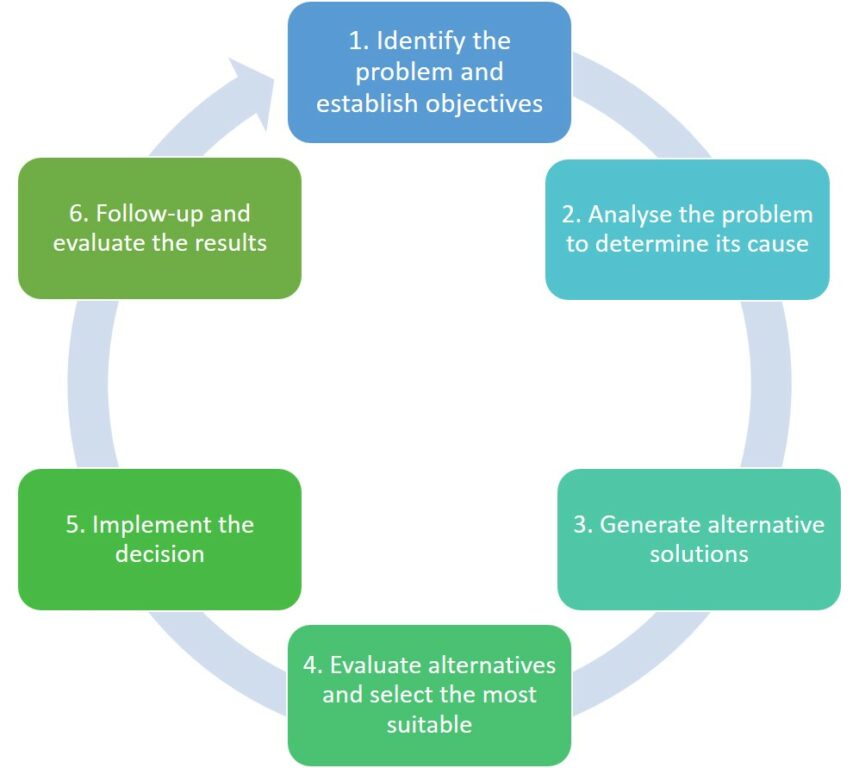
Although we are not always conscious of our method, most of us follow similar steps to solve problems. It is useful to increase our consciousness of these steps and apply a variety of proven problem-solving techniques to ensure we find effective solutions. Using the following process can improve our effectiveness in solving problems:

The process of solving problems

Identify the problem and establish objectives

This step is the most important and often the most difficult. It can be easy to jump into solution mode and spend surplus time looking for answers rather than having clarity on what really is the problem. Try to state the problem in a single sentence and ensure not to confuse the symptoms, the causes and the problem.

To establish objectives, think about the result you want. Compare where you are now and where you would like to be and be clear in what you are setting out to achieve.

Analyse the problem to determine its cause

In this step, it’s important to gather facts, ideas and opinions of others that may help in your analysis and assess the information without prejudice, preconceived ideas, or emotion to effectively determine the problem’s cause.

A technique used to uncover the main cause of the problem is to ‘ask why’ five times. Here is a ‘why’ chain for high employee turnover:

Why is there high employee turnover?

Why were the wrong people hired?

Why aren’t recruitment and selection techniques applied?

Why am I not confident in them?

Why is more training required?

We can determine from this chain the likely causes of this problem are poor selection and poor induction.

Generate alternative solutions

A choice of options needs to be considered in problem-solving. To find the best option, you must consider several solutions, that way you’re less likely to overlook the best course of action. Work on eliminating the cause of the problem and not just covering up its symptoms. Use brainstorming, creative thinking and ask others what they think to get the ideas flowing.

Evaluate the alternatives and select the most suitable

Evaluate your alternative solutions by considering the advantages and disadvantages of each. Remember the best solution will normally be the one with the most advantages and the fewest disadvantages. Ensure the most suitable option best meet your objectives.

Implement the decision

Now is the time to plan carefully how to implement your decision. Use the “who, how, what, where, why and when” prompts to develop your plan. Consider what could go wrong and how you will monitor progress to ensure your decision is working. Also, consider how you will communicate your decision to those impacted.

Follow-up and evaluate results

Routine follow-up checks will ensure that you have solved the problem. Check the symptoms again – have they gone? Take corrective action where necessary.

In summary, to continue to grow your problem-solving skills and build your personal effectiveness keep these guidelines front of mind:

  • Adopt a systematic approach
  • Focus on important decisions
  • Avoid making snap decisions
  • Don’t become a victim of analysis
    paralysis
  • Base your decision on facts
  • Don’t be afraid of making the
    wrong decisions
  • Learn from your mistakes
  • Use your imagination
  • Resist making decisions under
    stress
  • Make your decision and then move
    on

Enhance your problem solving skills with our short courses

As you can see, these skills are essential to enhance your leadership and deliver results to your teams and clients. To become the best leader you can be, consider enrolling in our short course on problem solving and decision making where you will learn all of the above guidelines and essential skills to tackle any problem head-on.