
Skip to content

The delivery layer: Why Australia’s productivity agenda depends on organisational leadership

September 2026

About the report

Australia’s productivity debate has largely focused on decisions made by government. But reform does not deliver itself. Whether new policy produces real gains often depends on what happens next – and on the organisational leaders and managers who must put it into practice.

Leadership is often discussed in broad terms or reduced to personality and charisma. This report takes a more practical view.

By mapping the Productivity Commission’s 47 recommendations against four practical capabilities, IML identifies where organisational leadership is needed across the reform agenda, examines what delivery demands of leaders and managers, and considers how Australia can better develop those capabilities.

The contributors

Sam Bell

Sam Bell

CHIEF EXECUTIVE OFFICER, INSTITUTE OF MANAGERS AND LEADERS AUSTRALIA AND NEW ZEALAND

Sam Bell is Chief Executive Officer of the Institute of Managers and Leaders Australia and New Zealand. His work has focused on strengthening management training pathways, developing a professional accreditation, and advancing the professionalisation of management and leadership. He has more than 15 years of senior leadership experience across financial services, education and professional associations, and holds an MBA and a Master of Public Policy.

Peter Achterstraat AM

NSW PRODUCTIVITY AND EQUALITY COMMISSIONER

Peter Achterstraat is the NSW Productivity and Equality Commissioner, a role he has held since the Commission was established in 2018. He was NSW Auditor-General from 2006 to 2013, and before that served as Chief Commissioner of State Revenue and as Deputy Commissioner of Taxation.

Saul Eslake

INDEPENDENT ECONOMIST
Saul Eslake is an independent economist. He was Chief Economist at ANZ from 1995 to 2009 and Chief Economist for Australia and New Zealand at Bank of America Merrill Lynch from 2011 to 2015, and in between directed the Productivity Growth program at the Grattan Institute. He is a Vice-Chancellor’s Fellow at the University of Tasmania.

The delivery layer:
Why Australia's productivity agenda depends on organisational leadership

In Meeting the productivity challenge, the Productivity Commission has set out 47 recommendations to lift Australia’s productivity – spanning tax, regulation, education, data and digital, care, and the energy transition. 

The conversation that has followed, in submissions to the Senate Select Committee, in the 2026–27 budget, and across industry and academia, has largely focused on the settings government can change: tax rates, regulatory frameworks, competition rules, investment incentives.

Far less attention has been given to a major delivery mechanism: the organisational leadership required to translate any of these recommendations into changed practice.

The Institute of Managers and Leaders (IML) examined that question directly, mapping all 47 recommendations against four leadership capability dimensions drawn from IML’s competency framework:

  • Driving organisational change
  • Developing people
  • Collaborating across boundaries
  • Workforce planning.

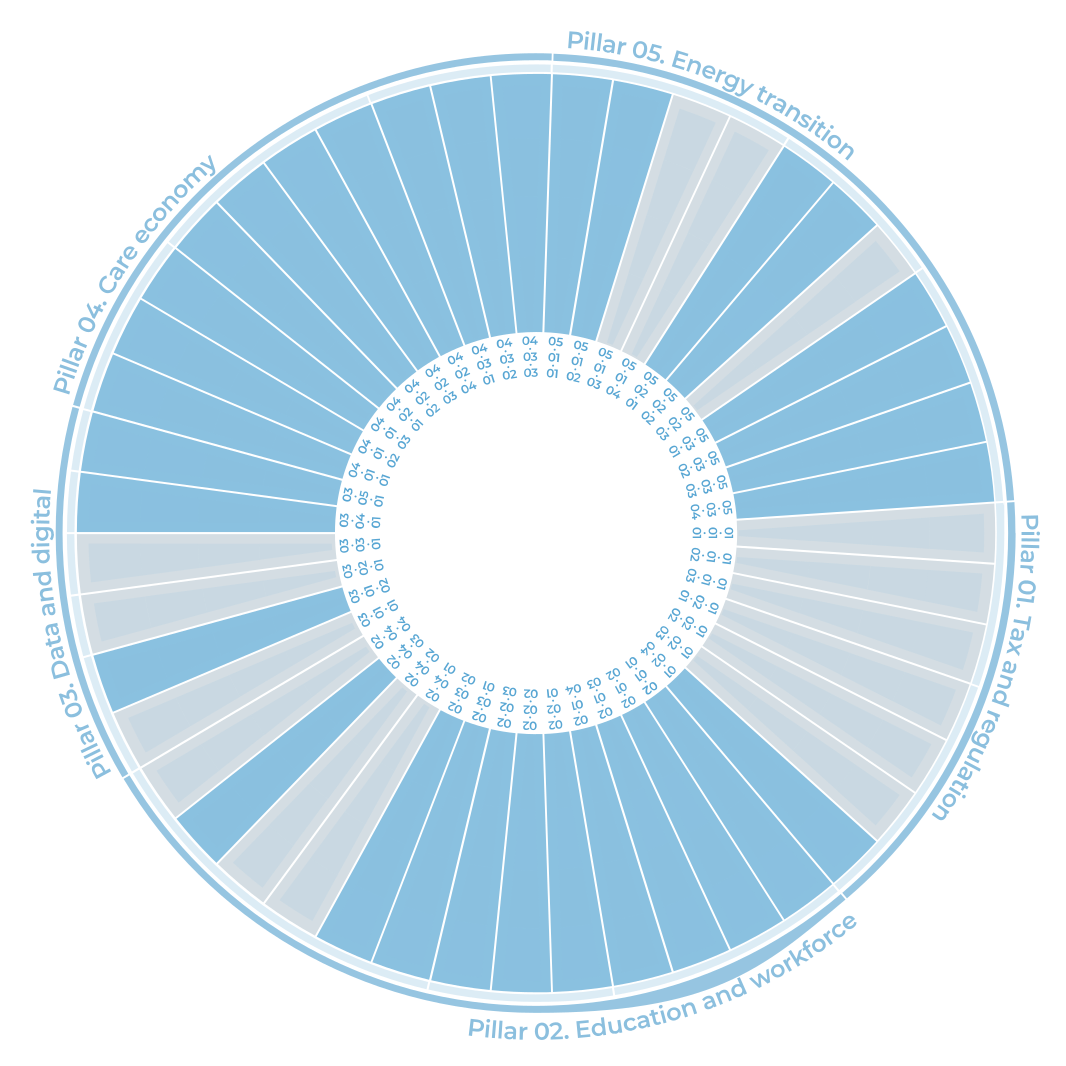
On IML’s reading, 32 of the 47 recommendations rely significantly on organisational leadership, which is two thirds of the reform agenda. In practice, that is the capability of leaders and managers within organisations to drive organisational change, develop their people, collaborate across boundaries, and undertake workforce planning. 

As a leadership body, IML has an evident interest in demonstrating that leadership matters. That position also gives it a particular vantage point: a competency framework built over decades of working with managers and leaders across sectors, and a direct line of sight to where capability gaps show up in practice. The mapping that follows should be read with that interest in view, and judged on the specificity of its analysis.

This discussion comes at a pivotal time for Australian productivity. Labour productivity growth has averaged under 0.3 per cent per year since 2015 – a fraction of the 60-year average of 1.6 per cent 1. The Commission estimates its recommended reforms could lift GDP by $13.3 billion from tax changes alone, with AI adoption representing a further $116 billion opportunity by the end of the next decade 2.

Realising those gains depends on whether the recommended reforms translate into practice. And IML’s mapping suggests that for the majority of the agenda, organisational leadership plays a significant role in that translation.

Snapshot findings

IML mapped all 47 of the Productivity Commission’s recommendations, asking of each – once in place, does its successful delivery depend significantly on leaders within Australian organisations, or does it take effect through government mechanisms?

How much of the Productivity Commission's reform agenda depends on organisational leadership?

68%

32 of 47 recommendations depend on leadership at the organisational level

32%

15 of 47 recommendations take effect through government mechanisms

Which of the Productivity Commission's five pillars depend most on organisational leadership?

100%

Pillar 4: Delivering Quality Care More Efficiently (Care economy)

77%

Pillar 2: Building a Skilled and Adaptable Workforce (Education and workforce)

73%

Pillar 5: Investing in Cheaper, Cleaner Energy and the Net Zero Transformation (Energy transition)

50%

Pillar 3: Harnessing Data and Digital Technologies (Data and digital)

14%

Pillar 1: Creating a More Dynamic and Resilient Economy (Tax and regulation)

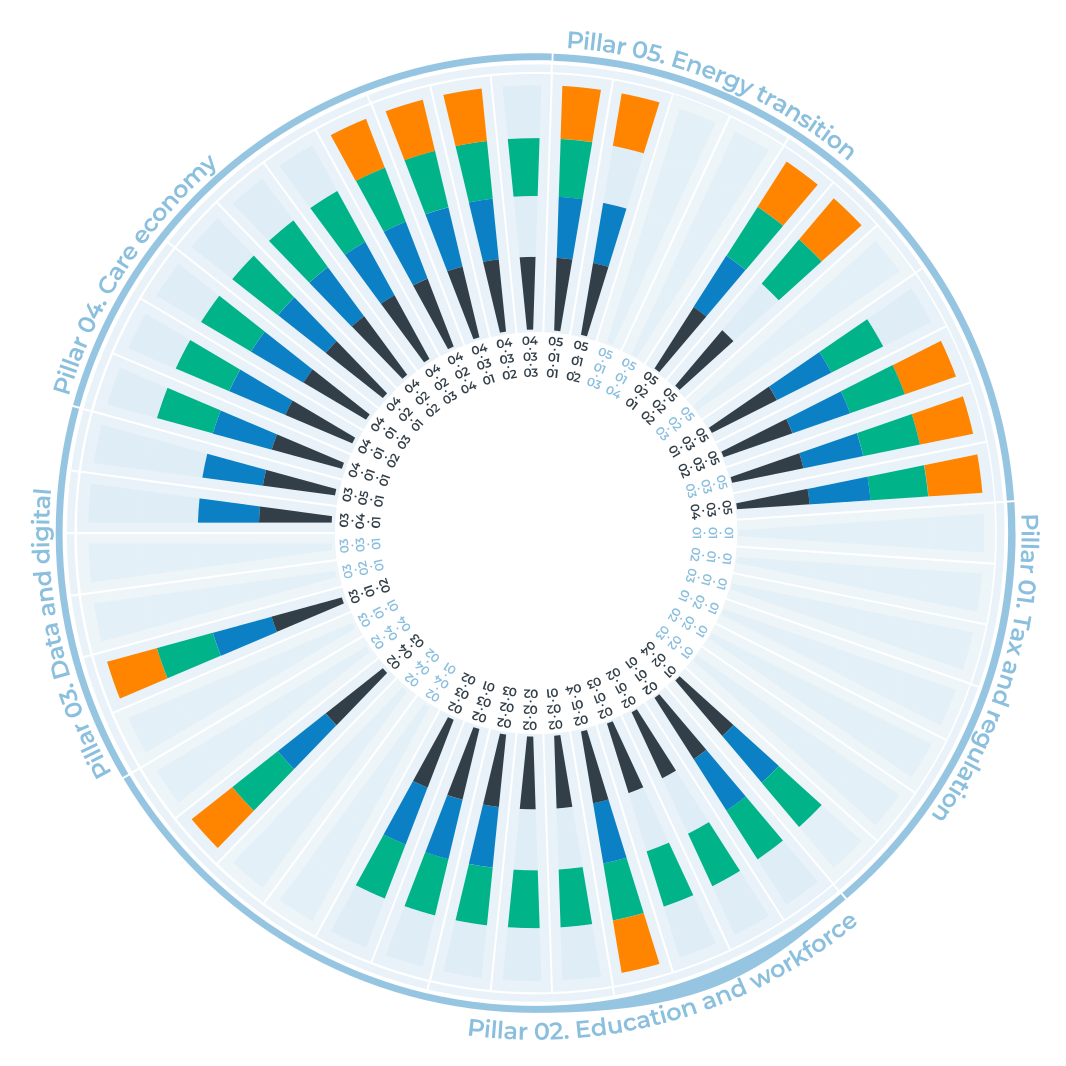
Of those 32 Leadership-dependent recommendations, which capabilities do they require?

100%

Driving organisational change and directing resources (the gateway)

81%

Developing people and building capability

91%

Collaborating across boundaries

41%

Workforce planning and restructuring

Between policy and practice

The gap between recommendation and response is not new. The Commission’s 2017 review Shifting the Dial set out 28 recommendations for productivity reform. Nine years later, no formal government response has been issued 3.

The Commission’s remit is to advise government, so its recommendations are addressed accordingly. But much of the delivery falls to people inside organisations, and the capability to do that is more often assumed than acknowledged, measured or invested in. That assumption points to a gap in the reform process.

While recommendations are formulated at the policy level, many require action within organisations to achieve their intended outcomes. Leaders must build the case for change, bring their people through it, and sustain the effort beyond the policy cycle. The policy process does not in itself provide the capability to do this.

"An idea is great, but you need to be able to implement it, and the way to implement is to have a narrative, and to persuade people – you've got to have the leadership capability."

Peter Achterstraat
NSW Productivity and Equality Commissioner

Understanding this gap requires a distinction. Government shapes the environment through tax, regulation, and competition settings. Within that environment, leaders and managers play a significant role in determining how work is organised, whether innovation is pursued, and whether reform translates into changed practice. This applies across both the public and private sectors. A department head driving operational change within a government agency exercises organisational leadership of the same kind as a CEO restructuring a business.

"Productivity is primarily the responsibility of the managers of firms. Not workers. Not governments. There's a tendency among business leaders to say that it's up to the government to lift productivity – by giving us tax cuts or by giving us subsidies or by deregulating the labour market or cutting red tape. I think to some extent business leaders are abdicating their own responsibilities."

Saul Eslake
Independent Economist
This report builds on that observation, examining leadership not as a general principle but through its component capabilities, and how they connect to the delivery of specific reforms. Grounding the discussion in identifiable capabilities and identifiable recommendations opens up a more specific conversation about the role leadership plays in translating productivity reform into practice.

The mapping applies one consistent test across all 47 recommendations, producing precise figures that are each an accumulation of qualitative judgements. As such, it is best read for the high-level pattern it uncovers in leadership’s role across the reform agenda, rather than as a definitive score for any one recommendation.

The Productivity Commission's 47 recommendations

The Productivity Commission set out 47 recommendations across its five pillar inquiries, brought together in Meeting the productivity challenge.

IML’s mapping assesses each one against four leadership capabilities. Read more about the methodology behind this mapping.

IML’s mapping of where organisational leadership matters across all 47 recommendations

OVERALL MAPPING LEVEL:
The headline finding

Two thirds of the productivity reform agenda rests on a layer the policy conversation has given comparatively little attention to.

Mapping data
Why it matters

The Productivity Commission’s 47 recommendations are directed at government. But only a third take effect through government mechanisms, such as tax settings, legislation, and regulatory redesign. The remaining two thirds depend on organisational leaders to drive organisational change and, in varying combinations, develop people, collaborate across boundaries, and undertake workforce planning. The mapping points to significant reliance on a layer the reform discussion needs to give more weight to if the recommendations are to be delivered. 

1. Capability patterns:
How leadership demands shift by sector

IML’s assessment suggests each pillar of the Commission’s reform agenda places distinct demands on organisational leadership.

  • In care, technology can rarely substitute for human leadership. Because it is predominantly a human-to-human industry, ‘cross-boundary collaboration’ appears in all ten care recommendations and ‘developing people’ in nine – the highest concentrations in the mapping.
  • In education, much of the challenge is jurisdictional. Reforms often cross state and federal boundaries, navigating regulatory systems that were not originally designed to connect seamlessly. Consequently, ‘cross-boundary collaboration’ dominates at 77 per cent.
  • In the energy transition, much of a sector is being built from the ground up – workforce capability, infrastructure, and coordination at once. It is the only pillar where all three non-gateway capabilities – developing people, collaborating across boundaries, and workforce planning – score equally, at 64 per cent. Workforce planning at that level also far exceeds any other pillar, reflecting how much of the workforce has yet to be built.
  • In the digital and AI space, the pillar overall shows moderate leadership dependency. But one recommendation reshapes the picture: the Commission’s position that AI-specific regulation be a “last resort” scores the maximum across all four capabilities – the only recommendation in its pillar to do so. Where regulation is a last resort, organisational leaders are expected to fill the space.
  • Macro-settings around tax, regulation, and competition sit largely on the government side of this mapping. Yet they shape the canvas on which leadership operates. As the reaction to the 2026–27 Federal Budget has shown, shifts in these levers provoke divisive debate precisely because they strongly influence whether entrepreneurialism and risk-taking are incentivised or constrained.
OVERALL MAPPING LEVEL:
Capability dimensions

The reform agenda asks for specific kinds of leadership.

Mapping data

Of the 32 leadership-dependent recommendations:

Why it matters

The four capabilities point to different leadership challenges in each pillar. In energy, the primary constraint tends to be workforce supply, with workforce planning at 7 of 11 recommendations. In care, the workforce exists but must be led differently, with developing people at 9 of 10. In education, cross-boundary collaboration dominates at 10 of 13. A generic approach to leadership development risks missing these differences. The capability gaps tend to be sector-specific, which points to the need for a response that is equally specific.

Turning diagnosis into leadership development

Breaking leadership down into distinct, sector-specific capabilities changes how we view its role in delivering productivity. It suggests these are not merely vague personality traits, but identifiable skills that can be actively trained and targeted to particular contexts.

"They are all skills that can be taught. They are management and leadership skills that can be developed. Organisations with stronger management practices are more productive, innovative, and adaptable. They're the three things this economy requires to drive productivity. And that is all driven by organisational managers and leaders – from a frontline level to a middle level to a senior level."
Sam Bell
Sam Bell
CEO, Institute of Managers and Leaders

While the mapping isolates these capabilities for diagnosis, in practice they often reinforce each other. Leading through organisational change develops the people who go through it, and capability built for one reform context can strengthen capacity for the next.

"You can train one particular person to be a better heart surgeon or a better plumber, but if you can lead the whole organisation or even your team, you'll be able to help 10 people rather than one."
Peter Achterstraat
NSW Productivity and Equality Commissioner

The return on leadership development is rarely linear. It tends to compound, and its value often extends well beyond the reform that prompted it.

2. The care economy:
Where people, not capital, drive productivity

Care concentrates leadership dependency more heavily than any other pillar in the reform agenda. In IML’s assessment, all ten of the Commission’s care recommendations are heavily dependent on organisational leadership for successful delivery, with ‘cross-boundary collaboration’ featuring in all ten and ‘developing people’ in nine. Workforce planning appears in only three. Care’s workforce pressures are real, but they are not the focus of these recommendations: they are primarily about how care is regulated, commissioned and supported, and ask leaders mainly to change how existing organisations and workforces operate, collaborate and build capability, rather than to expand the care workforce itself. In a sector where service is fundamentally tied to the person delivering it, improving productivity generally means improving how people are led.

In manufacturing or mining, a firm can often lift output by buying a faster machine or automating a routine process. In care, the service tends to be the human interaction itself. It is hard to speed up an aged-care shower or simply automate empathy.

Economists have a term for sectors where technology and capital cannot easily reduce the labour required to deliver a service: Baumol’s cost disease. It describes the constraint the care economy operates under.

"There's been no improvement in the productivity of chamber orchestras since Brahms and Beethoven. It still takes five players – two violins, a viola, a cello, and a double bass – to play a piece written for chamber music. Technology hasn't enabled you to produce a piece of chamber music with fewer than five trained musicians."
Saul Eslake
Independent Economist
Capital cannot easily substitute for labour in care. But the structural challenge runs deeper: market competition – which rewards strong management and penalises weak management in other industries – largely does not operate here in the same way.

The Frontline Imperative

Care reform is rarely delivered by the leaders who design it. It largely falls to supervisors, middle managers, and team leaders at the point of service.

"The recommendations mean nothing if frontline and middle managers aren't on board. They're the ones steering the ship for the customer. It's a human-to-human industry. You need people. It's not something AI will fix overnight."
Sam Bell
Sam Bell
CEO, Institute of Managers and Leaders

The Commission’s care reforms – collaborative commissioning, quality regulation, prevention frameworks – are ultimately delivered on the ground. They depend on supervisors coordinating between agencies, middle managers building staff capability under new standards, and team leaders steering delivery for the patient.

“There's not as much capital-labour ratio in the care economy. That's why it's so important that the labour side, the input side, is effective – and the best way for it to become effective is to have a good boss…You can wheel in a whole lot of new equipment, but it's not going to be much use if the staff aren't engaged.”
Peter Achterstraat
NSW Productivity and Equality Commissioner

The Commission estimates that collaborative commissioning could reduce potentially preventable hospitalisations by 5 per cent and emergency department presentations by 4 per cent, worth around $600 million per year 4.Whether that gain is realised depends not just on the policy design, but on whether leaders across the care system can coordinate, build capability, and sustain collaboration at the level where care is actually delivered.

IML’s assessment that all ten care recommendations depend on organisational leadership reflects this reality. In a sector where many traditional productivity mechanisms are constrained, leadership is not just one factor among many. It is often the primary lever left to pull.

3. The energy transition:
Why a sector in development requires the full breadth of leadership capability

The defining challenge of the energy transition is that it is not about refining an existing system, it is about building a new one.

In care and education, the institutions already exist. Leaders there scale and upskill a workforce, or navigate boundaries between established bodies. In the energy transition, the sector itself is still taking shape. New industries, new workforce pathways, and new institutional arrangements are being constructed alongside the system they will eventually replace. Building a sector places different demands on leadership than improving one that already exists.

The mapping reflects this pattern. Eight of the 11 recommendations in the energy and net zero pillar were assessed as leadership-dependent. Furthermore, all three non-gateway capability dimensions – developing people, collaborating across boundaries, and workforce planning – score equally at 64 per cent. No other pillar shows this even distribution. Care concentrates on two dimensions; education on one. In energy, leaders face all of them simultaneously. Five of the 11 recommendations requiring maximum leadership capability cluster here, making it the highest concentration of any pillar.

The skilled workforce gap beneath the energy transition

Physical delivery is an immediate challenge in building a new sector. The technical workforce the transition depends on does not yet exist at the scale required, and the transition is not the only industry laying claim to it.

"Engineers, quantity surveyors – there is a big bidding war for them between green energy work, housing, and infrastructure. They're out-bidding each other for the people."
Peter Achterstraat
NSW Productivity and Equality Commissioner

Government can set ambitious targets and underwrite the capital, but the infrastructure must be physically built. That requires leaders who can navigate fierce competition for the same limited pool of skilled workers. Redistributing talent between sectors without building total supply simply collapses one industry to serve another. This workforce planning challenge sits beneath much of the rest of the energy pillar’s agenda. And it is why workforce planning scores 64 per cent in this pillar, far exceeding any other sector.

Leading through purpose in the energy transition

Securing a workforce is only the first challenge; aligning it is the second. In an established sector, leaders can rely on settled organisational cultures and standard operating procedures to guide behaviour. In a sector still taking shape, that shared culture has not yet been built.

What holds a newly assembled workforce together when the playbook is still being written? For Bell, it comes down to purpose:

"Everyone needs purpose. People with purpose drive productivity – at every level, whether individual contributor, frontline leader, middle manager, or senior leader."
Sam Bell
Sam Bell
CEO, Institute of Managers and Leaders

When an industry is built from the ground up, a leader’s ability to communicate clear direction – where the work is heading and why it matters – gives people a reason to commit.

The breadth of leadership capabilities the mapping points to in the energy pillar reflects what leadership looks like during a sector’s formation period. The investment in developing those leaders will need to be correspondingly broad.

4. Education and workforce:
Navigating structural boundaries

One of the major challenges in reforming Australia’s education and workforce systems is the historical fragmentation across state and territory lines. The mapping points to this issue. Of the pillar’s 13 recommendations, ten are leadership-dependent, and cross-boundary collaboration is required in ten of the 13 – the defining capability demand of this pillar.

A key leadership challenge here extends beyond building capability or planning a workforce. It involves navigating state and federal boundaries that historically evolved to serve distinct local jurisdictions, rather than a seamless national market.

How state-by-state licensing fragments the workforce

These structural barriers are highly visible at the frontline, affecting every level of the workforce. Achterstraat provides an example from casual hospitality: his nephews, visiting from the Netherlands, must complete a separate responsible service of alcohol course in each Australian state before they can work in a bar.

Bell notes the same friction in professional accreditation: a state experiencing a teacher shortage may raise pay to attract talent, but a highly qualified teacher from interstate often cannot take the job without undertaking further study to satisfy a second registration board.

A similar pattern is evident across the broader workforce. The practical result is that labour often remains tied to where it is registered, rather than moving fluidly to where demand is highest. Bell connects this directly to the broader economic argument: “The whole definition of productivity is the allocation of capital and labour. This is directly speaking to labour.”

Left unmanaged, these bureaucratic structures can inadvertently constrain the efficient allocation of labour.

Why workforce harmonisation demands strategic leadership across jurisdictions

An intuitive remedy might be full harmonisation – aligning the frameworks nationally to let workers move freely. However, the reality requires more nuance.

"One of the advantages of a federal system is that it ought to allow different states to experiment. You wouldn't want to take harmonisation so far that states don't have room to experiment."
Saul Eslake
Independent Economist

Both perspectives hold weight. National consistency lowers costs and removes friction, but the room to try different approaches and learn from them has genuine economic value. While total harmonisation removes administrative hurdles, it risks eliminating the valuable policy learning that comes from state-level experimentation.

This suggests the leadership demands of the education and workforce pillar are strategic as much as administrative. The leaders negotiating national frameworks – in education departments, registration boards, and training regulators – are navigating a genuine tension between efficiency and experimentation. In doing so, they may be asked to compromise on local control in service of a broader national benefit that their individual jurisdiction might not fully capture.

That cross-boundary collaboration is required in ten of the pillar’s 13 recommendations reflects this ongoing reality. It suggests collaboration is less a temporary phase of the reform process than an enduring feature of a federal education system – one that relies on leaders at every level to navigate and bridge structural boundaries that are unlikely to disappear.

5. AI and last-resort regulation:
What falls to organisational leadership

Of the Commission’s 47 recommendations, the approach to AI regulation offers perhaps the clearest example of the delivery layer in action. The recommendation that AI-specific regulation “should be a last resort” places much of the responsibility for responsible adoption on individual organisations.

In IML’s assessment, this setting scores across all four capability dimensions – representing the maximum possible score. What makes this particularly revealing is how it exposes a direct relationship: a restrained policy setting demands highly hands-on leadership.

What AI regulation demands of organisational leaders

The Productivity Commission’s ‘last resort’ framing does not necessarily mean an absence of rules. Privacy, consumer, and workplace safety frameworks still apply. However, navigating this space safely relies heavily on the capability of leaders at the organisational level.

At the operational tier, Bell argues that AI adoption requires deliberate, intentional leadership rather than being left to emerge unevenly across a workforce. He notes that without a clear internal framework, organisations risk a ‘randomised’ application that invariably invites poor practices. Achterstraat compounds this concern from a risk and compliance perspective. He highlights that because privacy and data laws already apply to AI use, leaders who fail to govern its application risk real harm – not just to their organisations, but to the people affected by automated decisions.

Beyond internal governance, there is a broader macroeconomic condition for success. Where regulation is a last resort, much of the burden of building public trust falls to organisations themselves.

“It's not a last resort. There needs to be, as a first resort, rules and principles so that you can have a social licence for it. If we don't, there is going to be a popular revolution against it.”
Saul Eslake
Independent Economist

From these different vantage points – spanning operational, legal, and macroeconomic angles – a common thread emerges. Whether AI actually delivers its massive productivity potential is closely tied to the quality of leadership within the organisations deploying it. If leadership capability remains uneven across the economy, a policy setting that relies on organisational judgement risks producing highly uneven economic results.

Furthermore, this technological shift fundamentally changes what leaders need to be trained for. As AI absorbs more of the technical and analytical load, the capabilities that remain distinctly human – such as judgement, empathy, and complex decision-making – become more critical, not less.

Given AI’s rapid evolution, the policy setting here is fast-moving. In July 2026, the federal government established an Office of AI within the Department of the Prime Minister and Cabinet to bring a coordinated national approach to AI across the economy, including its effects on the workforce. How that coordination develops, and what it comes to ask of organisations using AI in their own operations, remains an open question, and given the pace of the technology, a live one for some time yet.

6. How tax and regulatory settings shape the environment for organisational leadership

The mapping draws a deliberate line between what government delivers directly and what depends on organisational leadership. Most of the Productivity Commission’s first pillar falls on the government side of that line: six of its seven recommendations are delivered through government policy, legislation or scrutiny mechanisms without requiring broader organisational mobilisation. The exception is the recommendation to change regulatory practice itself, which asks regulators to build capability and work differently, and so depends on leadership inside the public service.

These settings still matter. They create the environment in which leadership decisions about investment, risk and growth are made, so the third of the agenda that government delivers directly shapes the conditions for the two thirds that, in this mapping, rely significantly on organisational leadership.

The 2026–27 Federal Budget has opened a debate about whether current settings are striking that balance. The government’s own position is that the budget makes progress on 13 of the 17 reform areas the Commission identified across its five pillar inquiries. The budget factsheet points to $10.2 billion a year in regulatory burden reduction and around $13 billion a year in long-run GDP gains from national competition policy reforms 5

The Budget's capital gains changes vs. leadership and investment sentiment

The budget’s capital gains and startup equity changes have drawn strong criticism from parts of the business and startup community. Their argument highlights a vital tension: if the reform agenda requires a surge in business dynamism, but the regulatory canvas is perceived to disincentivise leaders from putting capital on the line, the two forces may be working at cross-purposes.

“Where does investment go in our economy to drive productivity and innovation? Leaders make those decisions. Whether you’re running the corner store or BHP, those leaders decide where the capital flows. You need a very stable environment. When you start tinkering with that, you create uncertainty across the economy and at an enterprise level. You want to incentivise ambition. You want people to want to start their own business, take a risk. That’s what grows an economy, creates jobs.”
Sam Bell
Sam Bell
CEO, Institute of Managers and Leaders

Whether changes to capital gains and startup equity settings risk disincentivising the ambition the reform agenda relies on is the open question, given many business leaders are warning that in a globally competitive economy capital and talent will move to where they are better rewarded.

Where policy intent meets business leadership and enterprise ambition

Eslake, however, highlights the political realities inherent in policy change. Reflecting on the budget backlash, he points to a dynamic where constituencies often complain more loudly when their privileges are removed than the larger number of people who benefit will ever speak up in support.

Rather than dismissing business concerns, this serves as a reminder of how sensitive enterprise ambition is to shifts in the economic canvas. In his assessment, the intensity of the reaction illustrates how much the canvas matters to the leaders operating within it.

"Government can't force people to do good things. It can give them incentives to do good things. It can set up frameworks. But ultimately it's up to the people operating within those frameworks to decide whether they want to do good things and if so to do them."
Saul Eslake
Independent Economist

When taken together, Bell and Eslake illustrate the fundamental division of labour in the reform agenda. Government sets much of the environment, but policy settings alone do not execute the work. Even if the government were to perfect the regulatory canvas – removing every structural friction – the central question of this report remains: does Australia have the leadership capability required to actually deliver the change?

Putting leadership on the productivity agenda

This report has examined what sits between policy intent and changed practice.

Using IML’s leadership framework, the mapping assessed two thirds of the Commission’s reform agenda as relying significantly on organisational leadership. The expert contributors show what that looks like on the ground. The question now turns to how we begin building that leadership capability.

The Senate’s Select Committee on Productivity in Australia is due to report on the drivers of productivity growth, including competition, tax, regulation and technology. Leadership as a productivity driver has received comparatively little attention, in the public submissions to date and in the broader conversation across government, industry and academia.

Australia’s experience suggests this deserves to change. The distance between recommendation and changed practice has been a recurring feature of the country’s reform history. The Commission’s own 2017 review Shifting the Dial set out 28 recommendations for productivity reform, many of them well-conceived and many still largely unimplemented. The current 47 recommendations – and the economic gains the Commission estimates they could deliver – are too significant to risk a similar outcome. Recognising organisational leadership’s role as a productivity driver within the Committee’s deliberations and the broader policy conversation would bring this delivery layer into a discussion that has so far focused on the settings above it.

The challenge differs by industry, and no single framework is likely to address it across all sectors. The gap the mapping points to is not at the level of governance or board oversight. It is operational, sitting with the managers and leaders who carry reform into practice at every level. Developing standards that reflect the sector-specific variation the mapping reveals would draw on institutions that work across industries and represent those leaders directly.

This report is IML’s contribution to that work, and to putting leadership on the national productivity agenda.

Why Australia needs a national leadership capability framework

Australia has no agreed economy-wide national framework for what good management and leadership capability looks like, and so no benchmark against which to measure, develop or invest.

While Australia has undertaken work at a national level to define leadership capability within parts of the public sector, including through the Australian Public Service’s Leadership Capability Framework 6, the UK has taken a coordinated approach to extending national investment in leadership and management capability into the business community through the government-backed Help to Grow: Management program 7. Its consistent curriculum, developed with employer bodies and delivered through accredited business schools, gives practical form to what management capability means and how it can be built. In doing so, it treats management capability as part of the productivity conversation and demonstrates how national policy can help build a shared understanding of that capability and support its development beyond individual employers.

For Australia, a more systematic approach would begin by agreeing what good leadership capability looks like across the economy, and then benchmarking against it.

The mapping offers a starting point for what such a benchmark would need to reflect. Different sectors place distinct demands on leadership – care concentrates on people development and collaboration, education on cross-boundary collaboration, energy on all capabilities simultaneously. A national benchmark would need to capture that variation rather than prescribe a single standard across the economy.

Once defined, these capabilities would need to be integrated into how leaders are actually developed. Workforce development programs in Australia focus overwhelmingly on technical skills. The mapping shows that collaboration, people development, and the ability to drive organisational change are required across the majority of the reform agenda – capabilities that are identifiable, teachable, and largely absent from the way Australia invests in its workforce.

“To translate policy into practice requires leadership. That's the bottom line."
Sam Bell
Sam Bell
CEO, Institute of Managers and Leaders

© Institute of Managers and Leaders 2026. All rights reserved. Developed in partnership with Media Collateral.

Turn these insights into action in your organisation

Download the PDF report and join our mailing list for more insights on leading through reform.

"*" indicates required fields

Name*

Endnotes

[1] Productivity Commission, Quarterly productivity bulletin – March 2026
https://www.pc.gov.au/ongoing/productivity-insights/bulletins/quarterly-bulletin-march-2026/

[2] Productivity Commission, Meeting the productivity challenge: Reform priorities from the PC’s five productivity inquiries, December 2025.
https://www.pc.gov.au/inquiries-and-research/five-productivity-inquiries/meeting-productivity-challenge/

[3] Productivity Commission, Productivity review (2017).
https://www.pc.gov.au/inquiries-and-research/productivity-review/

[4] Productivity Commission, Meeting the productivity challenge.
https://www.pc.gov.au/inquiries-and-research/five-productivity-inquiries/meeting-productivity-challenge/

[5] Australian Government, Productivity Package, Budget 2026–27.
https://budget.gov.au/content/factsheets/download/factsheet-productivity.pdf

[6] Australian Public Service Commission, Leadership Capabilities.
https://www.apsc.gov.au/initiatives-and-programs/learning-and-development/leadership-capabilities

[7] Department for Business and Trade, Help to Grow: Management – annual and impact reports, May 2023.
https://www.gov.uk/government/publications/help-to-grow-management-annual-and-impact-reports

Thank you for visiting our website.
For all enquires please refer to the contact us section of the website.

Office Closure

Thank you for visiting our website.
Please note during the holiday season our offices will be closed from the 22nd of December 2023 to the 2nd of January 2024.

For all enquires please refer to the contact us section of the website.