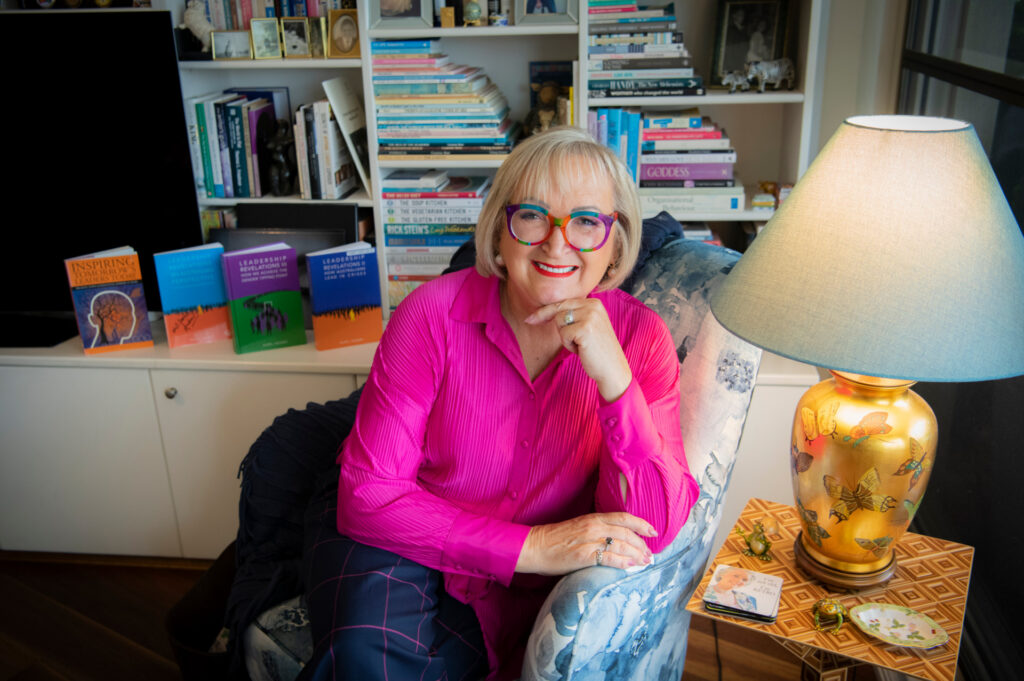

In this member spotlight, we feature Avril Henry AM FIML, keynote speaker and executive coach, whose career has focused on challenging entrenched thinking, advancing equity and developing female leaders. Drawing on four decades of experience, she shares insights on challenging the status quo, creating meaningful opportunities for women and building workplaces where courageous voices can drive lasting change.
You’ve spent four decades working with leaders and organisations to challenge entrenched thinking. What have you learned about what it really takes to create meaningful change?
Meaningful change requires leaders to understand the fundamental psychology behind human behaviour and reactions to change. Only 30% of people are comfortable with change, and 15 – 20% actively resist change. For change to work, leaders need to have an active communication strategy to take their people on the change journey with them by explaining the WHAT? WHY? WHO? WHEN? and HOW? Too often, the focus in change programs is on the products and/or services, technology and clients, with the people responsible for delivering the change not in the top three considerations.
Throughout your career, you’ve been described as “difficult”, “disruptive” and “too much”. What did those labels teach you about leadership and about whose voices organisations choose to listen to?
I learnt that when you ask “difficult” questions, challenge the status quo, the actions being taken, and why something is happening, or why it needs to be done a certain way, or you are bold and outspoken, you are seen as “difficult”, “disruptive” and “too much”. The people most often listened to are those who agree with the leaders, generally leaders who do not want to be challenged, and who do not want to explain their decisions and actions. Human beings are often most comfortable with people who look like them, sound like them and behave in similar ways. It is why diversity at work is often seen as challenging.
What do you think leaders most often get wrong when it comes to developing and retaining women?
The first assumption that is a common myth is that women with children are less committed than people without children. This is simply wrong! Women with children who work are often more organised due to the constant juggling act in their lives. Another myth is that women are not as ambitious as men. The reality is that women are often overlooked in favour of men due to this myth. Women are as ambitious as men, but we have socialised women to “wait their turn”, whereas men speak up if they are interested in a promotion or a new job. Women are not offered the same development opportunities as men and again, are reluctant to ask.
Leaders also assume that women do not want leadership positions – they do, but again due to socialisation and unconscious bias, women do not put their hands up for leadership roles. They often need to be encouraged to do so. Unlike men who will often tell you why they are leaving, women will simply leave after finding another job. Leaders need to have open conversations with female employees about their expectations at work of career, development and remuneration.
You help organisations understand that equity is “not a slogan, but a strategy”. What does that look like in practice for leaders and organisations?
Diversity, equity and inclusion is not a slogan, but a strategy when it is part of the overall business strategy in terms of attraction, recruitment, development and retention. It means that diversity is “simply how we do business”, it is not an add-on or a separate strategy where boxes are ticked once a year to meet compliance reporting. It means the business makes a conscious effort to include women and men when considering recruitment, promotions, pay rises and bonuses, and development opportunities, especially at external organisations. When women are missing from short lists, the leader asks: “Where are the women on this list?”
You’ve worked with some of Australia’s most influential and powerful leaders. What separates leaders who genuinely shift organisational culture from those who simply talk about change?
Leaders who develop organisational cultures that are psychologically safe, positive and productive in the first instance are listeners. They truly listen to their people, and they seek advice from multiple sources, making decisions informed by insights from others and their own experience. People in these organisations feel heard and therefore feel valued. They are inclusive, authentic, and not afraid to say: “I don’t know the answer. Let’s look at this together.” Or “I don’t know the answer, but I will get back to you once I do.” They are empathetic, with self-awareness and EQ, understanding the impact they have on others, without being weak. EQ and empathy are hallmarks of strong leadership.
Looking back across your career, is there a leadership lesson you wish you had understood earlier?
I wish I had learnt the importance of active listening in my 20s when I was a manager for the first time. One of the greatest lessons I learnt during a listening course in my late 30s was: “In life, you never get a second chance to hear something for the first time.” That was such an eye opener. My grandmother told me when I became Head Prefect: “God gave you two ears and one month because he wanted us to listen more than he wanted us to speak.” One of my favourite Australian leaders, Sir Angus Houston told me: “Great leaders listen more than they speak, because you learn more by listening and asking good questions.”
For women who aspire to leadership, what barriers do you believe still deserve more attention and what can leaders do to remove them?
While Australia has made significant progress, several barriers continue to limit women’s advancement into senior leadership.
I believe the key barrier for women is the unequal distribution of caring responsibilities, which does affect career progression, visibility and access to leadership opportunities. Research from the Workplace Gender Equality Agency (WGEA) continues to show that women remain underrepresented in senior leadership positions and experience a substantial gender pay gap despite improvements in workforce participation.
The second barrier is the lack of flexible leadership pathways. Many organisations still operate under the assumption that leadership roles must be full-time and always available, which exclude talented women balancing work and family responsibilities.
Third, we must address bias in promotion and succession planning. Often, sponsorship, visibility and informal networks play a significant role in career advancement, and women do have less access to these opportunities than their male counterparts.
Leaders can help remove these barriers by:
- Embedding flexibility into leadership roles and measuring outcomes rather than time spent at a desk.
- Creating truly transparent, unbiased promotion and succession processes.
- Sponsoring high-potential women and ensuring they are considered for critical projects and stretch assignments, to the same extent as men.
- Holding leaders accountable through measurable gender equity targets, e.g. remuneration and bonuses.
- Supporting parental leave and caregiving policies that encourage shared responsibilities for all genders, so it is seen as a people’s issue not a women’s issue only.
Ultimately, organisations will see greater progress when gender equity is viewed not as a women’s issue, but as a business and leadership imperative that benefits everyone.
Are there any major workplace shifts or trends you predict happening in the Diversity, Equity and Inclusion space over the coming 5-10 years?
Over the next decade, I believe DEI will become increasingly embedded into core business strategy rather than operating as a HR initiative.
One major shift will be a stronger focus on accountability and measurable outcomes. Organisations will face greater expectations from employees, customers, investors and regulators to demonstrate real progress on representation, pay equity, inclusion and workplace culture, rather than simply reporting intentions. Australia is already seeing increased transparency through gender pay gap reporting and workplace equality legislation (WGEA).
However, senior women in CEO roles and female board members of the ASX200 have declined in the past 12 months, as the focus on DEI has decreased.
A second trend will be the growing intersection between technology and inclusion. As AI becomes more integrated into recruitment, performance management and workforce planning, organisations will need to actively manage algorithmic bias and ensure equitable access to new opportunities and skills development for women and men.
I also expect inclusion to broaden beyond traditional diversity categories. There will be greater emphasis on neurodiversity, disability inclusion, intergenerational workforces, cultural diversity and psychological safety. Many organisations are recognising that diverse representation alone is not enough; people need to feel genuinely included and able to contribute. I have been saying this in keynote addresses at conferences for over 20 years!
Finally, inclusive leadership will become a defining capability for future leaders. I have predicted for over 20 years that the leader of the future (which is now) would need to be inclusive, a good listener, authentic, empathetic and genuinely interested in the people. The most successful organisations will be those that equip managers to lead diverse teams, foster belonging and create environments where people can perform at their best. As workplaces become more global, hybrid and diverse, inclusion will increasingly be viewed as a leadership competency rather than a HR initiative.
In short, the future of DEI will be less about compliance and more about creating high-performing, innovative and sustainable organisations where everyone can succeed.